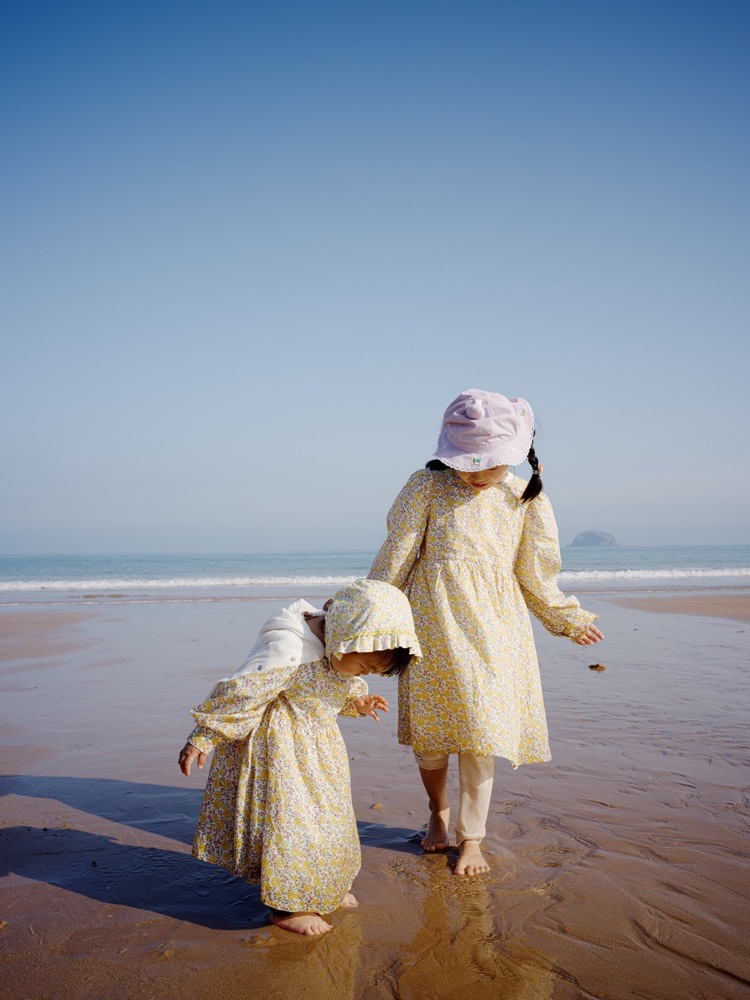
Liu Xiang / Family Imagery
While the father used a professional camera to build the family's visual narrative, the mother, Wang Jianan, recorded the same life in a completely different way: handmade albums, black cardstock, cut photographs, handwritten diaries in colored pen, spontaneous drawings and stickers. This is not a translation or annotation of the same story, but a second voice that grew naturally from inside the family. Here there is no concern for composition or light, only a mother's most private feelings: swollen legs during pregnancy, the exhaustion of feeding at three in the morning, the surprise of seeing a child smile for the first time. If the father's lens is a gaze, the mother's notebook is a murmur.
On one day when Muxin was 10 months old, nothing special happened. Starting at midnight, I made one photograph every half hour, 48 images in total. None of the photographs were directed, cropped or color-graded. Like an emotionless clock, they faithfully recorded an infant's most ordinary day. Yet within this almost mechanical repetition, time itself becomes the subject: sleep in the early morning, morning light, afternoon play, evening quiet and sleep again late at night. When the day ends, nothing has happened, and everything has happened.
Time passes swiftly, and life continues without end.
A set of family photographs traveled from the living room to places much farther away. It became a photobook, appeared on a magazine cover, entered exhibitions and was written into photography teaching material. These are not displays of honor, but a simple proof: when private feeling is expressed honestly, it gains the ability to resonate with strangers. The power of family imagery has never rested in technique, but in truth.