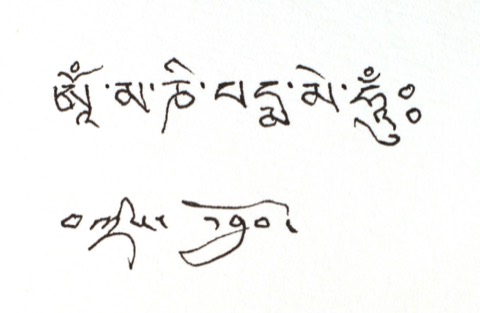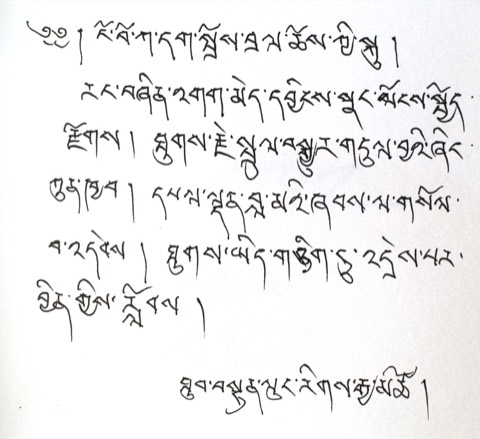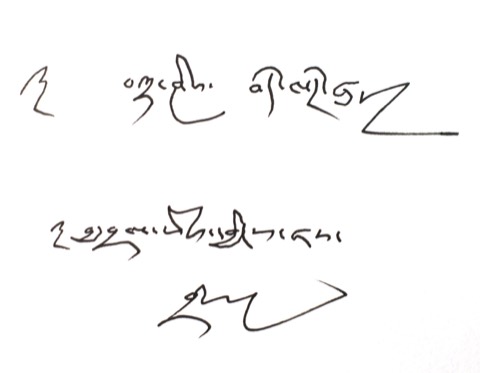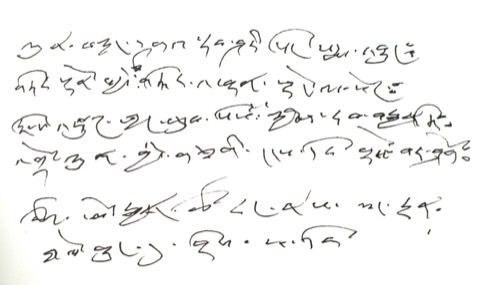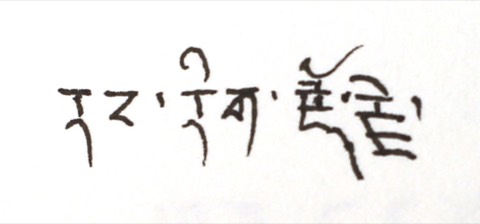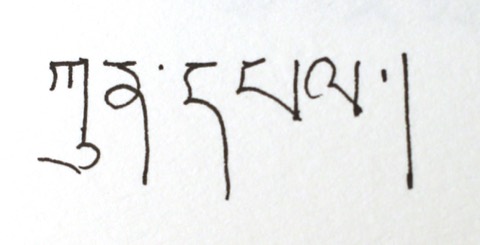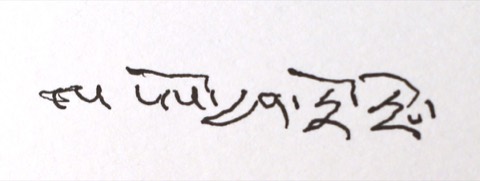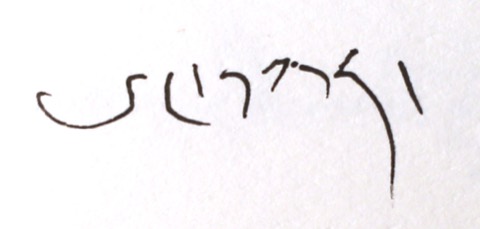
Wind Passes · Stone Holds · Lamp Shines
Liu Xiang · The Butter Lamp Remains Lit
The mind relies on the Dharma, the Dharma relies on renunciation, renunciation relies on the cave, and the cave ultimately relies on death.Scroll down
Wind Passes · Stone Holds · Lamp Shines
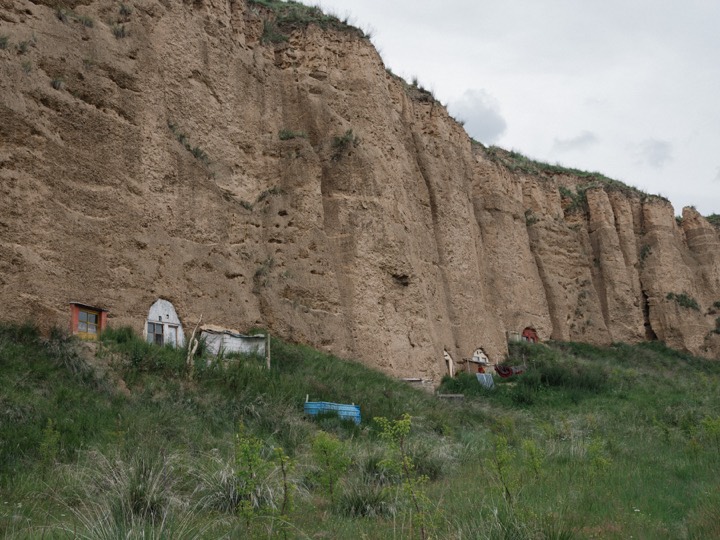
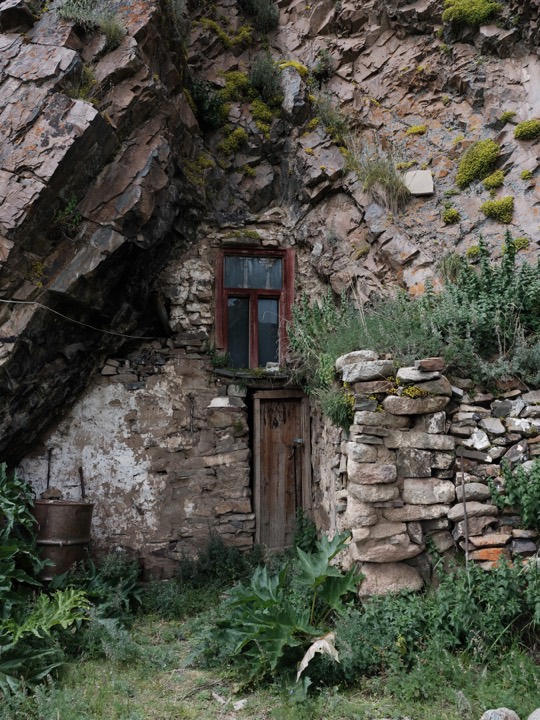
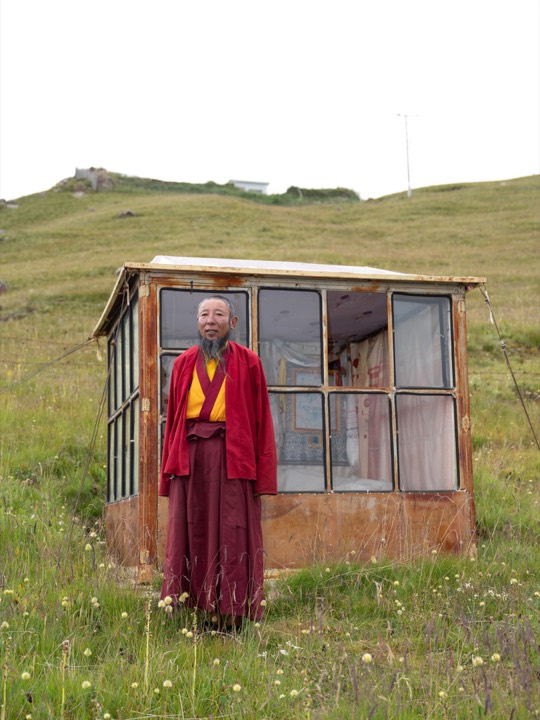
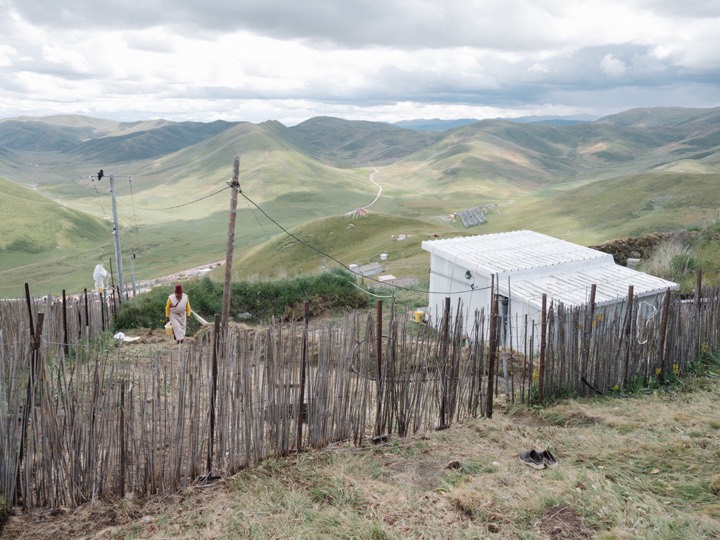
A simple retreat hut stands silent deep in the mountains on the border between Qinghai and Sichuan, as if time has paused here. In front of the camera, a practitioner in retreat stands quietly at the doorway. Behind the thin yet resolute figure are layers of vast mountain ranges and scattered lights flickering in the distance. This image reveals more than an individual's solitary practice; it reflects a way of standing against the current of the times. While the outside world moves forward relentlessly, these practitioners choose stillness to resist the noise and protect the pure land within.
The intense upheavals of the 20th century brought Chinese religious culture through a complicated journey from prosperity to decline and then revival. From destroyed monasteries and lost scriptures to the gradual restoration after the reform and opening period, spaces of faith experienced dramatic changes and reconstruction. Today, although religious activities are regulated within the national institutional framework and monasteries have reopened in an orderly manner, this institutionalization has also made personal and non-official paths of practice more difficult and hidden. The practice of retreat, as a special form of cultivation, has gradually been pushed to the margins of society. These practitioners hide in remote forests and abandoned monasteries, quietly seeking spiritual liberation in isolation from the world. This marginalization comes both from personal choice and from the particular circumstances of contemporary society.
As a practitioner of Tibetan Buddhism, I am not merely a detached observer, but also a participant in and guardian of this community. Because of this identity, I am able to enter spiritual spaces that are difficult for outsiders to reach, and present these sensitive images with sufficient humility and reverence. During the process of photographing, I deliberately removed geographical clues and specific identities in order to protect the privacy and safety of those photographed. At the same time, I focused more on the subtle relationship between the practitioners' expressions and their surroundings, allowing viewers to experience their solitude, solemnity, and dignity through these quiet, still images.
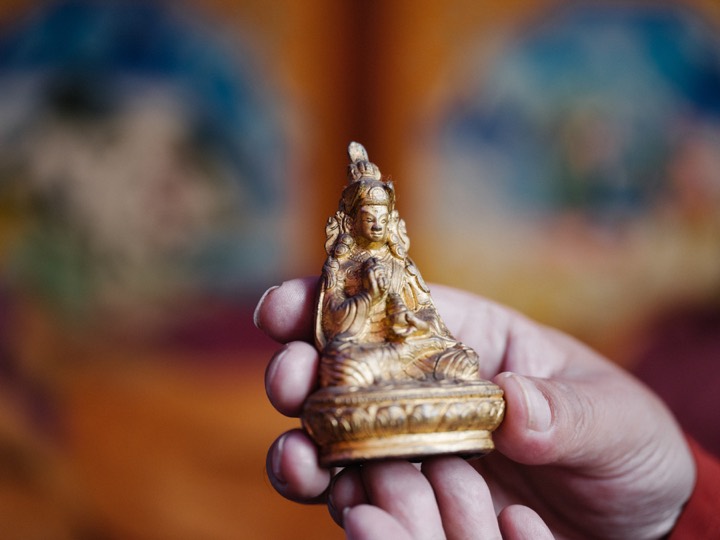
Yet within these hidden spaces deep in the mountains, one can still encounter various ritual objects and relics related to life and death. A strand of gray-white hair falling to the knees, a small figure painted on a skull, or a few-centimeter-long bone relic... These images feel both otherworldly and powerful. At first glance, they seem as subtle and sacred as death itself, but in the world of Tibetan Buddhism, these "bones" and "relics" are precisely regarded as evidence of the continuation of life and awareness. Each practitioner firmly places themselves within a unique rhythm of practice: bone relics, kapala bowls, prayer beads, and recordings on mobile phones are all vessels carrying the same purpose. When practitioners spend decades in retreat and seated in the mountains, when they use a clean sesame oil lamp to illuminate birds of prey, insects, and themselves, what emerges is not only compassion and perseverance, but also a way of embracing coexistence with all things in the world. Here, birth, aging, illness, and death seem to be condensed into a greater river of time. The human body is only a temporary vessel, yet through practice it can reveal infinite possibilities.
The rapid process of urbanization and the wave of secularization further threaten the continuation of this ancient tradition of practice. Younger generations are moving into cities in pursuit of material and worldly success, the experiences connected to this tradition are becoming increasingly scarce, and the practitioner community is facing a serious crisis of broken transmission. Through documentary photography, I record this cultural landscape that is close to disappearing. In every photograph, weathered faces and subtle, devoted traces of practice form a sharp contrast with the rapidly developing modern society outside, revealing a strong tension of the times. The images therefore become a precious historical record, preserving another way of life that continues stubbornly beyond mainstream narratives.
If the current of the times arrives like a flood, these precious bone objects, relics, and forest-dwelling practitioners become symbols of standing against the flow. Their presence tells us that between the worldly and the sacred, there are still people who choose a path that is relatively solitary yet full of meaning. As city lights shine and information technology roars, those who dwell in corners of mountain caves and endlessly recite scriptures continue to guard a seemingly irreplaceable spiritual landscape. Their stories may lead us to look back toward a quiet valley within the human heart, where amid external noise and the impermanence of life and death, an undying awareness and compassion still shine.
The First Door
When one steps inward, the cave is no longer desolate, but a place of clarity.
The true cave is in the heart; when the heart can renounce the world, the city is the same as the forest.
Tibetan Buddhism often uses a verse to encourage disciples: “The mind relies on the Dharma, the Dharma relies on renunciation, renunciation relies on the cave, and the cave ultimately relies on death.” These four stages progress like a staircase, leading one step by step toward a vast openness of mind. “Renunciation” does not mean rejecting the noise of the world, but learning to stop oneself at the edge of desire and distraction. The “cave” does not refer only to a stone chamber, but to any place that is removed from worldly splendor and returns to what is genuine. “Death” is the final strike, breaking attachment to arising and passing away, allowing the two shores of life and death to become one clear expanse. In just over twenty words, the verse outlines the complete path of a practitioner, from the arising of a pure mind to the insight that penetrates life and death.
For this reason, the Qinghai-Tibet Plateau and the neighboring regions of India, Nepal, and Bhutan have long been places of aspiration for those who wish to follow this path. In the snowy land, “renunciants” (called “Larangba” in Tibetan) live in stone caves, ice valleys, or wooden houses, accepting poverty and solitude in the hope of gaining freedom from the cycle of rebirth through unwavering faith. They practice both for their own liberation and for the liberation of others — believing that only after lighting one's own lamp can one illuminate the night of all beings.
In ancient texts, the figures of ascetic masters appear everywhere: snow peaks as blankets beneath the sunlight, cold rocks as beds in the depths of night; nettles to fill the hunger, ice and snow gathered to quench thirst. The words of Milarepa, “May I fall ill with no one asking, and die with no one grieving,” still echo through the fierce winds of the snowy mountains. It was the most decisive letting go of worldly attachment, and the most sincere guardianship of faith. For most people living in cities today, such a state can only be approached through words and imagination.
Transportation and technology have brought new possibilities. The plateau's airstrips are no longer just isolated runways; mountain roads, though still steep and dangerous, are now enough to carry photographic equipment and oxygen tanks deep into the ranges. I consider myself an ordinary person, yet I am also drawn by that ancient call — when the conditions came together, I set out on the journey with a Khenpo and guides.
Only after arriving did I understand that the word “hardship” was far beyond imagination: practitioners in retreat often have no phone contact and leave no address; stone houses hide deep within the mist, mountain paths appear and disappear, and even GPS can no longer continue. We drove hundreds of kilometers, then walked along cliffs and crossed marshes; sometimes our breathing became only a thin thread, and each step beneath our feet felt like walking on a trembling cloud. Even then, reaching the entrance of a cave did not mean we would meet the person inside — some were in deep retreat, while others respectfully declined visitors from the outside world. With the introductions and blessings of several teachers, we were finally able to open those tightly closed wooden doors and see the faces that lived beside clear lamps and ancient Buddhas.
The sentence they said most often was: “This is the teacher's instruction.” Dongsa Dorje remained silent for sixteen years because of this, and jokingly called himself a “madman” by writing the words on a yak skull outside his door. Sadong Dorje, because of the Dharma King's words “to form connections with people,” spoke for the first time after years of silence. Longre Jiancuo carried an image of Padmasambhava and traveled between Haixin Mountain and Wutai Mountain, simply because “the teacher told me to go.” Osel Dorje had already been recognized as a tulku, yet he put the certificate away and openly said that without his teacher's permission, he would not reveal even these small secrets. For them, the teacher is not only someone who imparts teachings, but also a guiding lamp, a boat across the river, and a rope suspended in the sky — without that light, even the direction of the first step would be impossible to confirm.
Several years passed in an instant. Back in Beijing, I sat before the keyboard again and wrote these words. Beyond the night, the neon lights of high-rise buildings made the butter lamps inside the caves seem especially distant. I still recite mantras every day, yet I often lose focus when a WeChat notification sounds or when the delivery bell rings. The prayer beads slipping through my fingers are mostly just counting repetitions; my inner progress is like the morning light through the haze in northern Beijing — slow, but eventually revealing a faint brightness. During this time, Moza Dharma King passed into the light, and Tangre Rinpoche also departed with rainbow light. A new yogi has lit the morning practice lamp in the stone cave of Zuoqing. I have not yet had the chance to visit, and my heart already carries a sense of regret for the delay.
Yet the words of a great master often return to my ears: “The true cave is in the heart; if the heart can renounce the world, the bustling city is the same as the forest.” I understand that the journey has not ended. When the next wind comes from the plateau, perhaps I will once again pack my prayer beads and quick-acting heart medicine, and set out along those narrow paths between countless stones and missteps, only to confirm whether the prayer flags are still flying and whether the clear lamps are still faintly burning — and also to confirm whether this easily scattered heart of mine has learned, at the place where ripples arise, to recognize the nature of water.
The Second Door
Nineteen practitioners and one monastery, each opening onto its own silence.
01
“Samsara has no true meaning. Only through the Dharma can one attain true liberation.”
66 years old, from Jianzha County in Qinghai. He has been in retreat for thirty years. Before entering retreat, he completed the Nyingma school’s preliminary practices three times; the third time took eight full years before he truly felt the integration of his mind and the Dharma.
When I arrived in Xining, Sonam and Khenpo Jiatuo Mai had already arrived several days earlier. Most of the yogis in retreat did not have phones and rarely contacted the outside world. Even their family members found it difficult to see them. In addition, retreat locations were often remote and hidden, and Khenpo had gone to great lengths to find Tashi Dondrub.
As soon as we got off the plane, we hurried to a restaurant because we were unsure whether we would be able to have a normal lunch later during the journey. During the meal, Khenpo told me in detail about the yogi we were about to interview—Tashi Dondrub.
Tashi Dondrub is 66 years old this year. He was born in Jianzha County, Huangnan Tibetan Autonomous Prefecture, Qinghai Province, and is a yogi of the Nyingma school of Tibetan Buddhism. The Chinese translation of his name means “Auspicious Perfection.” Sonam and I joked that perhaps his name was a sign that our journey would go smoothly and auspiciously.
Tashi Dondrub has been in retreat for exactly thirty years. Before entering retreat, he completed the Nyingma school’s five preliminary practices three times: taking refuge, generating bodhicitta, reciting the Vajrasattva purification mantra, mandala offering, and guru yoga. Each practice required one hundred thousand recitations.
During his first practice of the preliminary practices, he admitted that he was only trying to reach the required number and was not truly focused inwardly, so he decided to practice again. During the second practice, his family sent him large amounts of food and supplies. He felt ashamed, thinking that he was like livestock being fattened and that he was not truly practicing. Therefore, he completely gave up meat, became vegetarian, and decided to practice a third time. This time, it took him a full eight years to complete the practice, and he truly felt the integration of his mind and the Dharma.
Tashi Dondrub once said: “Samsara has no true meaning. Only through the Dharma can one attain true liberation; this is the deepest meaning of life. Before practicing, I felt that the Dharma was only moments of happiness, suffering, and confusion. After practicing in retreat, I truly experienced the peace and rest that the Dharma brings to the mind.”
His three root teachers are Khenpo Banma Wangjie, Banma Gesang, and Banma Renzeng. They are all renowned practitioners of the Nyingma school, especially with profound realization and experience in teaching Dzogchen. In the Nyingma school’s Dzogchen teachings, practitioners attain awakening and liberation by directly recognizing and resting in the natural state of the mind. The retreat practice undertaken by Tashi Dondrub was precisely a process of deeply experiencing this direct realization.
Traditional Tibetan Buddhist retreats are usually practiced in caves in the wilderness, where the environment is extremely harsh. However, Tashi Dondrub humbly told us: “Those yogis in the past were the true retreat practitioners. They endured hardships unimaginable to ordinary people in simple caves. My place now is too comfortable, with both water and electricity. I feel that I am not truly practicing in retreat, but rather enjoying myself.”
When I met Tashi Dondrub, I found his face calm and kind, with clear and deep eyes. Many yogis have hardly ever been photographed in their entire lives. Some do not even have identification cards or household registrations, completely outside the ordinary social system. In Tashi Dondrub’s lifetime, his identity photo was also his only image record.
The photographing process was not easy. Tashi Dondrub had to meditate four times every day, leaving us very limited time for photography. I had hoped to record moments of interaction between him and his family, but that did not happen. During the shoot, he stood in front of the camera looking tense and restrained. Even when I gently guided him, his expression remained difficult to relax, and the images appeared somewhat stiff and rigid.
Sonam and I felt somewhat disappointed about this, but Khenpo Jiatuo Mai, who accompanied us, calmly said that it was enough as long as we had captured his image. He was accompanying us only out of compassion and joy, and did not pay much attention to the quality of the photographs. Sonam privately told me with emotion: “Tibetans still have a distance to overcome in their understanding of this kind of outside culture.”
After the photography ended, Tashi Dondrub personally saw us down the mountain. As he stood on the hillside watching us leave, a natural and peaceful smile finally appeared on his face. It was a kind of tranquility and compassion like mountains and water. At that moment, I felt that he had truly returned to the most natural state of a practitioner.
On the way back, I kept recalling what Tashi Dondrub had said: “Practice is not about whether the external environment is difficult or comfortable. What truly matters is whether the mind can find rest in the Dharma.” His words made me reconsider my own path of practice and strengthened my determination to continue exploring and practicing the Dharma and to go deeper into the teachings of Dzogchen.
He understands practice as allowing the mind to truly find rest.
02
“Retreat is my passion, and it is my life.”
47 years old. Since the age of 35, he has practiced retreat in sacred places including Haixin Mountain in Qinghai Lake, Wutai Mountain, India, Nepal, and Sangye Qingpu in Tibet. He believes that places where accomplished masters have practiced and blessed can in turn bless those who come later.
Caves for retreat could be seen everywhere along the way, but many of them were suspended on steep cliffs. Ordinary people would find them extremely difficult to climb unless they had professional mountaineering skills, or possessed the ability to fly like tantric accomplished masters described in legends.
The place we were heading to was Zoqing Retreat Cave in Tongde County, Hainan Tibetan Autonomous Prefecture, Qinghai Province, one of the most renowned retreat sites in Tibetan Buddhism. Places like this usually have no phone signal, and there are no clear markers on maps, so we could only ask for directions as we went. However, everyone gave different answers, adding more difficulties to an already challenging journey.
The car moved slowly along rough, muddy roads. To reduce the burden of walking for me, Khenpo Jiatuo Mai took the risk of driving up a slope that was nearly sixty degrees steep. Sonam, who was sitting in the car, was so frightened that he cried out. However, the car lasted for less than a minute before reaching a cliff edge where it could go no further. In the end, we still had to walk. For me, someone afraid of heights, suffering from altitude sickness, and dealing with a leg condition, this was a serious challenge.
After a full day of jolting travel and getting lost several times, we finally arrived at our destination. When I stepped into the cave where Longre Jiancuo practiced retreat, my legs were still trembling uncontrollably.
Longre Jiancuo is 47 years old this year and was born in Tongde County, Hainan Prefecture. There were five brothers in his family. According to local tradition, his family asked a Khenpo from a monastery to perform divination and determine which child was most suitable for leaving home to practice. The result showed that Longre Jiancuo was the one most suited for this path. He became a monk at the age of 13 and formally received vows under Dharma King Jigme Phuntsok at the age of 15.
Retreat practice is an important way of practice in the Tibetan Buddhist tradition. Khenpo Qiujia once gave a widely circulated teaching: “The mind relies on the Dharma, the Dharma relies on renunciation, renunciation relies on caves, and caves rely on death.” This teaching expresses the firm belief of Tibetan yogis seeking liberation—by leaving worldly life behind and practicing deep meditation in places of solitude, they seek freedom and liberation of the mind.
Longre Jiancuo followed this teaching and began his path of retreat at the age of 35. From then on, he traveled among different retreat sites. He practiced retreat on Haixin Mountain in the center of Qinghai Lake for six or seven years, stayed at Wutai Mountain for two or three years, and also left his footprints in sacred places such as India, Nepal, and Sangye Qingpu in Tibet. Practitioners believe that practicing in sacred places where qualified masters have previously undertaken retreat can bring special blessings, more effectively purify the mind, and quickly deepen understanding and realization.
I asked him curiously: “Is there any special meaning behind frequently changing retreat locations?”
“In the past, accomplished masters blessed these places through their practice, making them sacred places. Now these sacred places, in turn, bless us.” Longre Jiancuo answered softly.
I asked him again: “When walking in the ordinary world, what would you do if you met a beautiful girl you liked?”
He smiled shyly at the question, his face turning red: “Of course I would meet people I like. But at that moment I remind myself that I am a practitioner, and I can only regard her as my younger sister.”
“Over all these years, have you ever thought about giving up?” I continued asking.
Longre Jiancuo seriously shook his head: “It is indeed very difficult to persevere, but I have never wavered. Because this is the teaching of my master.”
The cave was extremely narrow. Apart from a simple wooden bed, stove, and cabinet, there was almost nothing else. The three of us sat cross-legged, with barely enough space to stretch our legs. After more than an hour, my legs had become numb and unbearable. Yet Longre Jiancuo warmly offered us what he considered the most delicious food—oil cake lumps. The cakes were very dry and hard, almost without flavor, and difficult to swallow. Khenpo and Sonam managed to eat some. Later, Khenpo quietly told me: “We should eat less of yogis’ food, because their living supplies are already extremely limited.”
Before leaving, I offered Longre Jiancuo five thousand yuan on behalf of my friend William. He humbly refused several times before reluctantly accepting. This money was very precious to him—every few months, he would go down the mountain to a small shop to borrow a phone and ask the owner to ride a motorcycle to deliver necessary daily supplies. Later, I learned that this offering eventually helped him fulfill his wish of going to Zoqing Monastery to seek teachings.
On the way back, a storm seemed to be approaching on the mountain road, and low clouds pressed down over the mountains. As we bumped along the road, I repeatedly recalled Longre Jiancuo’s words. The sentence that moved me most was:
“Some people do their practices in a scattered way, while others do them with concentration. Perhaps the difference is not great for some people. But for me, the difference is great. Because retreat is my passion, and it is my life.”
The Buddhist concept of “renunciation” refers to a sincere and pure wish to be free from attachment and desire toward the world of samsara. This is not passive withdrawal from life, but a strong longing for liberation that arises after realizing the impermanence and emptiness of all phenomena. The Dzogchen teachings in Vajrayana Buddhism directly guide practitioners to recognize their originally pure and complete nature of mind, gradually stabilize in this awareness through meditation, and ultimately attain complete awakening.
Looking back at the mountain road below, the wind grew stronger, yet my heart gradually became calmer. Although the journey was difficult, just as Longre Jiancuo said: “The mind relies on the Dharma, the Dharma relies on renunciation, renunciation relies on caves, and caves rely on death.” Beyond life and death lies true freedom and peace.
For him, long-term retreat is not a posture, but a clear choice of life.
03
“We do not distinguish between any schools. We only uphold Guru Rinpoche’s teachings.”
In a small storeroom behind Lari Monastery, he shared an old wire bed with a cook. Known as the “modern Jigong,” he often waited by the hillside outside the monastery in a wheelchair, choosing the place closest to people as his own position.
After leaving Tongde County, we headed northwest on our return journey, passing around Lajia Canyon and traveling through the vast, desolate mountains on both sides. Several hours later, we finally arrived at Lari Monastery in Gansu.
Lari Monastery is a large and well-known Tibetan Buddhist monastery in the surrounding region. The monastery sits among the valleys, and when looking up, prayer flags stretch like a rainbow, seeming to lead the eyes toward the sky. Behind this magnificent monastery, an inconspicuous small warehouse became our destination.
The warehouse was filled with all kinds of miscellaneous items: daily necessities, sacks of vegetables, old furniture… They occupied almost all the space. Only a corner at the very back could barely fit an old wire bed. Half of the bed belonged to a cook, while the other half was the living space of the tulku Xiazha Qiuyang. This was where he lived.
Xiazha Qiuyang Rinpoche has a very high reputation among people in Tibetan areas and is known as the “modern Jigong.” When I first saw him, he was sitting in a heavy wheelchair, with gentle features and a calm, simple smile. His daily range of movement was extremely limited. Every day, he relied on his wheelchair and an old small car to move from the foot of one mountain to another, and he never entered the monastery’s magnificent prayer halls. Instead, he stayed beside the hillside outside the monastery, waiting at any time for believers who came seeking teachings and blessings.
According to people close to the tulku, he made this choice in order to shorten the distance between himself and believers as much as possible, allowing everyone who came to visit to feel comfortable. Whether Tibetan or Han Chinese, people could approach him without barriers, share their troubles, and seek compassionate answers.
Visitors came one after another, with crowds patiently waiting in line to meet him. I observed beside him for a long time: no matter who they were, regardless of wealth or status, the tulku patiently listened to everyone’s worries and then gently offered guidance. Someone offered a khata, and he kindly accepted it. Someone else came only because a sick cow at home needed help, and he listened carefully and patiently gave advice. His teachings were simple and plain. He almost never quoted difficult scriptural terms, yet he could always comfort people’s hearts with precision.
At one moment, a question suddenly arose in my mind, and I could not help asking the tulku: “In Tibetan Buddhism, there are many schools including Nyingma, Gelug, Kagyu, Kadam, Sakya, and Jonang. Each school seems to have different focuses and methods of practice. What exactly are the differences between these schools?”
After hearing the question, Xiazha Qiuyang Rinpoche smiled lightly and shook his head. He did not directly answer the differences between the schools, but instead said in an extremely plain tone: “We do not distinguish between any schools. We only uphold Guru Rinpoche’s teachings.”
The sentence was extremely simple, yet full of meaning.
Guru Rinpoche, also known as Padmasambhava, is regarded as the founder and most revered teacher of Tibetan Buddhism, especially the Nyingma school. He spread Buddhist teachings widely in Tibet and established a rich and complete tantric lineage, especially Dzogchen. Dzogchen emphasizes that every person already possesses an originally pure and complete nature of mind. There is no need to seek outwardly; under the guidance of a teacher, by directly recognizing one’s own original awareness, one can attain ultimate liberation and freedom.
The tulku’s simple words reflected the inclusiveness and breadth of true Buddhist teachings. In fact, the essence of Buddhism has never been about divisions between schools, but about the deepest care and guidance for the inner world of every sentient being.
Later, during another interview, I asked another yogi, Wujin Cairang, the same question. His answer was almost identical to the tulku’s: “Fundamentally speaking, all religions that encourage people to do good ultimately lead to the same destination through different paths, not to mention the distinctions within Buddhism itself.”
Behind their simple answers was the true wisdom of Tibetan Buddhism—the ultimate purpose of Buddhist teachings is to help all beings leave suffering and attain happiness. All schools and methods are, in the end, simply different bridges, guiding beings toward the other shore of liberation.
His compassion does not depend on grand halls, but on truly being close to people.
04
“The Dharma is already here, and the magnificent golden hall has also been built. What is missing now are truly dedicated practitioners.”
At the age of 93, he still practiced quietly in a simple room. After spending several days traveling with him, the author was repeatedly reminded by him: do not only look at appearances, and do not rush to judge others, because what people see is often only one side of the matter.
Whenever I mention Moza Dharma King, a sense of reverence always arises in my heart. He is one of the supreme leaders of the Nyingma school of Tibetan Buddhism and is widely regarded as an emanation of Vajrapani Bodhisattva. It is said that simply meeting him once can bring extraordinary blessings. Therefore, I never dared to hope that I would have the opportunity to meet him in person.
The journey to visit the Dharma King was far more difficult than I had imagined. We drove from before dawn until late at night, yet on the rough mountain roads we had traveled less than 300 kilometers and were still far from our destination. Many places in Tibetan regions remain untouched by modern civilization. The bumpy and difficult roads slowly wore down our patience. With no other option, we found a small hotel along the way to rest.
A local friend warmly recommended a hot pot restaurant. As soon as we entered, the owner enthusiastically introduced that all the fish there were alive. Hearing this, the three Buddhist practitioners who followed the principle of not taking life could only leave awkwardly. At the second restaurant, Khenpo and Sonam began discussing the Buddhist idea of non-discrimination: “Practice should have no distinctions, but if one truly achieves complete non-discrimination, one should not care whether the fish is alive or dead. None of us can do that.” The discussion ended without a conclusion. After all, we are ordinary people, still far from ultimate realization.
Early the next morning, Khenpo Jiatuo Mai excitedly knocked on my door: “The Dharma King is actually nearby!” The sudden news left me both surprised and flustered. We did not even have time to marvel at the wonder of this connection before rushing over.
Meeting Moza Dharma King for the first time was not what I had imagined a high-ranking religious leader would be like. He was quietly practicing at home. At 93 years old, he had seen the rise and fall of worldly splendor and had long since put aside worldly dignity. He sat in a simple room, with his daughter carefully taking care of him nearby. The old man’s eyes were clear and peaceful, and every wrinkle on his face seemed to tell stories of wisdom and compassion accumulated over the years.
Several years ago, a foreigner once asked the Dharma King: “There are said to be one hundred thousand rainbow body attainments at Kathok Monastery. Is there historical evidence to support this?” At the time, the Dharma King could not answer, and afterward he began intentionally collecting information about practitioners who had attained the rainbow body.
[Note: Rainbow body attainment is considered one of the most sublime forms of passing away for practitioners of Tibetan Buddhism. When a yogi who has completed practice approaches death, their body is said to gradually shrink, eventually transforming into a rainbow that merges into the sky, or leaving behind precious relics. Kathok Monastery, one of the three great vajra seats in Buddhist history, is said to be the monastery where the most rainbow body attainments have appeared.]
The Dharma King’s thoughts coincided with ours, and he even allowed us to accompany him for the following several days. For any Buddhist practitioner, this was an extremely rare and precious opportunity. Receiving Moza Dharma King’s approval made Khenpo Jiatuo Mai approach this photography project with even greater seriousness. It changed from simply helping a disciple into following an instruction from his master that could not be refused.
The Xiangtou Monastery we visited with the Dharma King was a newly built monastery, funded and constructed by the tulku Silong Garong, who had been recognized by the Dharma King. The monastery was designed by an American architect and contains the tallest Thousand-Armed and Thousand-Eyed Avalokiteshvara statue in Tibetan regions. Although it differs from the style of traditional monasteries, it remains magnificent and richly decorated.
Tulku Silong Garong was also part of the group traveling with us. He drove a luxury car, and his manner of speaking and behavior carried a kind of sharpness and worldly sophistication more like a businessman. Sonam and I privately discussed him and had some criticisms, but later the Dharma King’s words reminded us: everyone only sees one side of things, not the complete truth.
On the way, we encountered a landslide and had to stop and wait. Taking this opportunity, we quickly got out of the car and chatted with the Dharma King for a while. He casually took out a piece of paper from his clothing. On it were photographs of a rainbow body practitioner before cremation and after cremation. “This practitioner was an actor during his lifetime. He drank alcohol, ate meat, and lived in an unconventional way. He looked completely unlike a practitioner. Yet in the end, he attained the rainbow body. You have no qualification to judge others, because what people see is only the surface, not the truth of things.” The Dharma King said calmly.
After a short pause, he looked at us and said quietly: “What you are doing requires a lot of money, even to the point of losing everything.” Sonam and I immediately replied that we had already prepared ourselves and sought no fame or benefit. The Dharma King gently nodded, as if he had already understood everything.
After we returned to the car, Sonam whispered in amazement: “Those two conversations we just had—he was clearly in another car. Why did it seem like he heard everything?”
The journey remained long, and after many turns and detours we finally arrived at Xiangtou Monastery. A drive that should have taken three hours eventually took more than ten hours. By the time we arrived, it was already past dinner time, and the 93-year-old Dharma King ate only a few bites before going to rest. Khenpo Jiatuo Mai later told me that the Dharma King went to sleep at midnight every day, woke up at 3 a.m. to recite prayers, and often traveled between different monasteries to give teachings.
Early the next morning, Xiangtou Monastery held a grand consecration ceremony. Hundreds of believers came from all directions to pay their respects. The line stretched from the monastery entrance all the way to the main hall, creating a solemn and magnificent scene. Seated in a wheelchair and pushed by attendants, Moza Dharma King took blessed grains in his hand, recited prayers, and scattered them toward each statue of Buddha inside the hall to consecrate them one by one.
The Dharma King occasionally liked to make jokes, but they always contained profound contemplative insight. After the ceremony, he saw a mirror inside the hall. Pointing at his reflection in the mirror, he smiled and said: “The person in the mirror says he is real. You say you are real. Who, then, is truly real?” A simple joke caused everyone present to fall into deep reflection.
Before leaving, he specially showed us the leg bone relic and body relic of the actor he carried with him. The leg bone relic was grayish white, while the body relic seemed to emit a faint glow, as if silently conveying the power of the Dharma and evidence of realization.
“Now the Dharma exists, and the magnificent golden hall has also been completed. What is missing now are truly practicing people.” The Dharma King said this with emotion before we departed.
These words echoed in my heart like the morning bell and evening drum, lingering for a long time. Indeed, magnificent halls may be solemn and beautiful, but without people who truly devote themselves to practice, even the most splendid buildings are only empty appearances.
This brief experience of traveling with Moza Dharma King allowed me to truly experience the integration of the Dharma and daily life—the meditation on the image in the mirror and the real person, and the true awakening symbolized by the rainbow body. It is not a miracle, but a clear light that already exists within each of us. As long as we continue to remind ourselves, it remains there and never disappears.
Leadership and everyday simplicity exist side by side in this chapter.
05
“This compassion is not based on any miraculous external force, but rooted in a sincere wish for all beings to be happy.”
One of the most renowned tertöns in Tibetan regions. When we met him, he was already elderly, staying at his daughter’s home. His room was simple and tidy, with an image of Guru Rinpoche standing against the wall and a faint scent of butter lamps in the air.
Tangre Rinpoche was one of the most renowned tertöns in Tibetan regions. He was regarded as the reincarnation of a realized disciple of Padmasambhava and carried the responsibility of discovering and spreading precious terma teachings. In 2020, this tertön master, deeply respected by Tibetan believers, passed away, leaving behind endless remembrance.
[Note: In the Nyingma tradition of Tibetan Buddhism, Padmasambhava and his close disciples are said to have hidden many precious teachings and sacred objects in sacred mountains and lakes, known as “terma.” When the right conditions mature, the reincarnations of realized disciples return to the world, reveal these hidden teachings, and spread them. These reincarnations are called “tertöns.” Since the first tertön in Tibetan history, Sangye Lama (1000–1080), successive tertöns have played an important role in the continuation and flourishing of the Nyingma tradition.]
When we met Tangre Rinpoche, he was already elderly and staying at his daughter’s home, where she carefully looked after his daily life. His room was simple and clean. Against the wall stood a peaceful and solemn image of Guru Rinpoche, and a faint scent of butter lamps filled the room. Some devoted Tibetan believers come to respectfully request Rinpoche’s guidance after a family member passes away. Through ritual visualization, he helps them understand the deceased person’s destination and rebirth, and advises them on how to help the deceased reach a fortunate realm or pure land.
In Tibetan areas, this tradition of seeking guidance from a teacher is very common. Rinpoche usually tells visitors which specific scriptures they need to recite, how many times they should recite them, and how many mani stones they should carve, in order to help the deceased reduce suffering and be reborn in a favorable place.
My maternal grandmother passed away when I was less than one hundred days old. However, because my grandmother had always been respected by our family for her outstanding qualities as a teacher, I asked Rinpoche with some curiosity about her rebirth. Rinpoche looked ahead with kindness and seriousness. After a brief period of visualization, he told me: “Your grandmother has already been successfully reborn. In this life, she has also taken refuge in the Dharma and follows a very accomplished and good teacher. You can rest assured and do not need to worry.”
I felt greatly comforted. When I wanted to ask further about my paternal grandfather’s whereabouts, Rinpoche seriously explained that such matters were extremely sacred and should not be treated as a casual game.
Before leaving, he compassionately gave me a precious string of prayer beads and told me that I must first recite the Amitabha heart mantra one hundred thousand times before wearing them. He told me that these prayer beads are regarded in Tibetan areas as a powerful protective object, and wearing them can prevent the disaster of being struck by lightning. I quietly thought that even without wearing prayer beads, the chance of being struck by lightning seemed extremely small. Tibetans seem to especially like using “being struck by lightning” to describe rare misfortunes. Yet Rinpoche’s compassionate blessing deeply moved me. Later, I carefully took apart the string of beads and gave them one by one to my friends, hoping each person could stay away from disasters and receive protection.
This journey had originally included a visit to another highly renowned tertön, Banma Chenlie, who had revealed the supreme Dzogchen teachings of the Nyingma school of Tibetan Buddhism. However, two days later, when we finally made the difficult journey to the monastery where he was staying, we only saw a locked gate. If we had been able to contact him by phone beforehand, perhaps we could have avoided this long journey and regret.
Later, we twice heard that Banma Chenlie Rinpoche had appeared in other places. We immediately went to look for him, but we never had the chance for a deeper conversation. We only hurriedly took some portrait photographs and failed to fulfill our wish for a face-to-face interview. Sadly, this greatly respected great tertön also passed away not long afterward.
Looking back on these opportunities that involved so much travel but were ultimately missed, I cannot help feeling a trace of sadness and regret. However, Buddhist teachings often remind us that all things arise through causes and conditions, and when those conditions disappear, they return to emptiness. What we are able to encounter is due to conditions; what we miss simply means the conditions have not yet matured.
Just like the prayer beads given by Tangre Rinpoche, although they appear to be an ordinary string of plastic beads, they carry countless compassion and blessings within them. This compassion is not based on any miraculous external force, but rooted in a sincere wish for all beings to be happy—this is the most genuine compassion and wisdom in Buddhism.
His chapter connects with the lived experiences of death, rebirth, and compassion.
06
With modern transportation making travel more convenient, I departed from Beijing and arrived at Charang Monastery, located in the northwest of Dari County, Golog Tibetan Autonomous Prefecture, Qinghai Province, after only one flight transfer and a long, bumpy bus ride. This renowned monastery of the Nyingma school is now presided over by another highly respected leader of the Nyingma school — Banma Luozhu Dharma King.
[Note: Charang Monastery was founded in 1895 by Langzhi Banma Langduohe Jiacuo and is located in the northwest of Dari County, Golog Tibetan Autonomous Prefecture, Qinghai Province. According to legend, this place was once the location of King Gesar's palace, and today it has become one of the important centers of practice of the Nyingma school of Tibetan Buddhism.]
At my first sight of Charang Monastery, I was struck by its magnificent scale. The monastery contains not only a grand main hall, a spacious residence area for lay practitioners, and a solemn sky burial site, but most remarkably, one hundred retreat rooms built here by Banma Luozhu Dharma King, forming a large-scale retreat center. These retreat rooms were built according to the shape of the mountain and are scattered orderly across the slopes. Any practitioner may apply to the monastery, and each retreat can last three years, five years, or even as long as ten years. Some practitioners moved into these rooms from the day they were completed and have remained there for decades, even spending the rest of their lives there.
Unlike the ascetic retreats commonly imagined in tradition, the retreat conditions here are relatively modern. Water, electricity, and mobile phone signals are all available. Even the practitioners' daily food and living arrangements are provided by the monastery, along with a small living allowance. This form of practice may have less of the material hardship associated with traditional ascetic practitioners, but it greatly reduces the worries of daily life, allowing practitioners to devote themselves more fully to inner meditation and cultivation.
Incidentally, Charang Monastery also has a small shop that specializes in various Buddhist supplies: monastic robes, incense, offering lamps, offering bowls, and more. Prices range from dozens of yuan to over ten thousand yuan. The most famous item is the incense brought from the distant Minzhulin Monastery in Tibet. The person in charge of the shop is a man named Gongzhong Lama, a longtime friend of Jiatuo Mai Khenpo and also someone with strong business sense. Under his careful management, this modest shop surprisingly generates hundreds of thousands of yuan in annual revenue. This year, he expanded several rooms upstairs and converted them into a guesthouse, specifically providing accommodation and meals for Han Chinese lay practitioners who come to attend annual Dharma assemblies. Together with income from offerings by devotees, these two sources can reach one to two million yuan each year, enough to support the monastery's daily expenses.
Although the monastery operates with a modern management model, Banma Luozhu Dharma King, who oversees this place, is an extremely serious and cautious ordained practitioner. Jiatuo Mai Khenpo and Sonam had once worried that, given the Dharma King's serious manner, he might not approve of or even allow us to photograph and interview the retreat practitioners. However, the Dharma King's response was unexpected — he not only welcomed the idea, but personally selected a list of thirteen people for us from the one hundred yogis in the retreat center. These thirteen practitioners were, in the Dharma King's view, the people with the greatest achievements in practice and the ones most worthy of visiting.
The Dharma King's list was, for our interview plan, the most valuable key to opening the door. These retreat practitioners usually live in seclusion and almost never interact with the outside world. Without the Dharma King's personal approval and recommendation, it would have been impossible for us to approach them. With the Dharma King's clear support, Jiatuo Mai Khenpo became even more devoted to our plan, carefully arranging every step again and again, afraid of disappointing the Dharma King's expectations.
During my stay at Charang Monastery, I repeatedly thought of the Dharma King's serious yet kind expression when he spoke with us. He emphasized more than once: “The external conditions of retreat have improved greatly, but true retreat is still a complete separation between the mind and the outside world. If a retreat practitioner only remains physically in a cave while the mind still longs for worldly pleasures, then no matter how difficult the material conditions are, it is not true retreat. On the other hand, even with modern conveniences, if one can completely separate from inner desires and truly remain settled in meditation, then a modern retreat room can be equally excellent.”
On the day I left Charang Monastery, sunlight slowly descended from the horizon, illuminating the hidden retreat rooms outside the monastery in golden light. From a distance, the homes of these secluded practitioners appeared quiet and mysterious. Behind every door might be a long journey of inner practice. At that moment, I finally understood: retreat is not an escape from the world, but a temporary step backward to see the inner self more clearly and confirm one's direction again.
07
“Without the guidance and blessings of my teacher, I would never have had the opportunity to walk the path toward realization and liberation.”
At a hidden retreat site more than ten kilometers from Charang Monastery, he keeps a kapala bowl, recorded teachings on an old mobile phone, and scriptures personally given to him by his teacher. That place is like a greatly condensed scene of lineage transmission.
Most of the 100 retreat houses at Charang Monastery are scattered on the hills behind the monastery, but this time we first went to a hidden retreat site more than ten kilometers away. This place is said to be the natural practice site of Vajrakilaya, and local people hold it in great respect. Khenpo Jiatuo Mai specifically mentioned a practitioner named Dezhuo here. Although he was not on the list given to us by the Dharma King, Khenpo insisted that Dezhuo’s level of practice was extraordinary and worth visiting.
The car stopped at the foot of the mountain. I looked up and saw that the mountain ahead was not very high, but extremely steep, with almost no proper path. While I was hesitating and had not yet prepared myself for the climb, two Tibetans walked out from a nearby tent and warmly told Khenpo: “There is no need to go up the mountain. The tulku came down today, and you can meet him below.” Later, we learned that these two Tibetans were actually Dezhuo’s relatives.
Soon afterward, we met Dezhuo. This yogi looked ordinary and peaceful, yet carried a quiet and inward strength. He had maintained the full vows of a bhikshu for seven or eight years and practiced not eating after noon every day in memory of his most respected teacher and family members. During our conversation, Dezhuo said: “In my heart, the blessing power of the teacher is no different from the Buddha, but the kindness of the teacher toward me is greater than that of the Buddha. Without the guidance and blessings of my teacher, I would never have had the opportunity to walk the path toward realization and liberation.”
After saying this, he looked gently ahead and took out a bowl made from a human skull (kapala). This bowl originally belonged to Langzhi Banma Langduo Hejiacuo (Lang Lama), the founder of Charang Monastery, and was considered to carry great blessing power. Three days earlier, this precious lineage object had only just been passed into Dezhuo’s hands. After receiving it, the first thing he did was fill the bowl with yogurt and respectfully offer it before a Buddha image. Only today, when we arrived, did he take it down and share the yogurt that had been offered inside.
[Note: In Tibetan Buddhist tradition, ritual objects made from the skulls of highly accomplished masters after their passing are called kapala and are regarded as sacred objects with extraordinary blessing power.]
Besides the kapala bowl, Dezhuo also showed us an ordinary-looking mobile phone. Surprisingly, this phone had also been left behind by a yogi who had passed away. Although there was no communication signal here, the yogi had stored many precious Buddhist scriptures and recorded teachings on the phone during his lifetime. Dezhuo now uses this phone as a recorder, listening to the Dharma teachings on it day and night.
While talking with Dezhuo, he also told us about the last time he met a close relative—his great-uncle. That day, he had originally brought some food to visit the Dharma King. Passing by his great-uncle’s courtyard, he decided temporarily to offer the food to him instead. Coincidentally, his great-uncle was having breakfast, and there was still some roasted barley flour in the bowl. His great-uncle smiled and accepted the food, but took twenty yuan from the bowl and put it back into his hand. After that brief meeting, Dezhuo never saw his great-uncle again, and the unfinished bowl of roasted barley flour became an everlasting memory. His daily practice of not eating after noon is to remember his great-uncle and that simple but deep bond.
When discussing his understanding of practice, Dezhuo said softly: “People are easily confused and easily deceive themselves. We think we can see clearly, but often we cannot see reality. Therefore, at all times we must rely on the power of the Three Jewels. Otherwise, when impermanence arrives, we will be helpless and completely lost.” His tone was calm, but every sentence touched the heart.
When Dezhuo first came here for retreat, he brought only a box of instant noodles, a simple bedding set, and an image of Guru Rinpoche. This image had been brought back from Chamdo by his teacher when the teacher was young. At that time, the teacher was not wealthy, but still insisted on bringing the image back and personally handed it to Dezhuo before sunrise. Along with the image, he also gave him precious Dzogchen Trekchö and Tögal scriptures, telling him: “Protect these scriptures better than you protect your own life.”
When I left Dezhuo’s small retreat hut, it was already close to dusk. The setting sun shone diagonally onto the steep rock walls, turning the mountaintop a gentle gold. Looking back, that simple hut seemed like a small island hidden outside the ordinary world, carrying the simple and genuine faith of countless practitioners. At that moment, I understood clearly: Dezhuo did not need magnificent halls or a prominent reputation. His mind continued to protect the most genuine and pure lamp of awakening.
The simple hut preserves an extremely precious path of practice.
08
“In my entire life, all my important choices have actually come down to one sentence—listen to the teacher.”
49 years old. After his mother passed away when he was 19, he went to seek teachings from Mense Rinpoche and then spent thirty years in retreat. He originally did not want contact with the outside world, but because of the Dharma King’s words, “form connections with people,” he stayed here and, for the first time, made an exception and spoke.
Climbing the mountain was unavoidable in the end. The next day, after asking for directions along the way and getting lost several times, we finally drove the car to the halfway point of a mountain. This area has an average elevation close to 5,000 meters, with ranges of mountains stretching one after another. Looking into the distance, I could vaguely see several fluttering prayer flags. That was the destination we were about to visit.
Sonam and Khenpo helped carry part of my photography equipment. I carried three oxygen bottles and fast-acting heart-saving pills. After taking a deep breath, I used both my hands and feet and slowly climbed upward.
The plants on the mountain grew above my knees, dense and tough, making it impossible to see a path. The ground was covered with sharp broken rocks, and together with severe altitude sickness, I quickly fell behind the group. When I realized I was lost, I happened to jump down from a large rock and landed on a small isolated patch of grass in a swamp. I picked up a dead branch and tested the ground around me. All four directions were muddy swamps, and their depth was impossible to judge.
It was impossible to jump back, and the surroundings were strangely quiet. My calls only created echoes. After a long inner struggle and after finishing half a bottle of oxygen, I could only close my eyes and make a desperate leap—fortunately, with the protection of the Bodhisattva, the swamp was not too deep and only reached above my knees. Under the intense sunlight, my wet pants quickly became covered in mud. I then carefully crossed a narrow cliff section, almost crawling on my entire body to get across, and finally reached the prayer flag tower.
The person in charge here was Sadong Dorje. He is 49 years old and was born in Sangrima Township. There were many brothers in his family, eight in total, and surprisingly four of them became monastics. His original reason for becoming a monk was not particularly noble—he simply did not want others to look down on him. In Tibetan areas, monastics hold a respected position. Sadong Dorje became a monk at Sangrima Monastery at the age of 16. When his mother passed away at 19, several local village groups gathered travel expenses to help him go to Mense Rinpoche to seek teachings. He followed Mense Rinpoche for three years and then began his long retreat life, which has now lasted thirty years.
He never learned to read throughout his life, and he does not go to believers’ homes to recite scriptures or prayers. He said: “Rather than forcing myself to do these things, it is better to sincerely seek a teaching, practice seriously, and go into different caves for retreat. Then my destination in the next life will not be too bad.”
Whenever Sadong Dorje stayed somewhere, people would often come from afar to make offerings and pay respects. However, he never liked contact with the outside world. Deep inside, he always wished to find a place unknown to others where he could quietly practice retreat. However, Banma Luozhu Dharma King told him: “At the appropriate time, you should also form connections with people.” Following the Dharma King’s instruction, he eventually chose to stay here, but vowed never to speak again and entered a period of silence. Our visit was the first time he had made an exception and spoken in decades—naturally, this was also because he had the Dharma King’s permission.
[Note: Silence practice means refraining from speaking. In Buddhism, it is believed that the root of beings’ continuous cycle of rebirth lies in the three karmas of body, speech, and mind. If one can eliminate speech-related karma, one can quickly purify the mind and move toward liberation. One meaning of silence practice is reducing the creation of speech karma.]
Speaking about his past practice, Sadong Dorje gently recalled: “When I went to Lhasa to seek teachings in the past, for three years I did not eat even half a fist-sized piece of butter. I only ate a small piece of meat. I ate only one meal a day. Although my stomach was empty, my heart was very happy. When I first entered retreat, I did not even have a place to sleep. The retreat cave was damp and leaked water all year round, so I could only lie on the rocks outside. At that time, material conditions were extremely poor, but my mind was quiet and clear, and my practice was actually better.”
He shook his head again with a trace of self-blame: “Now conditions are simply too good. There is electricity, there is a refrigerator, and the Dharma King even provides food and support, but my practice is actually worse than before. In the past, one candle was only lit before sleep and could last three or four months. Now life is comfortable, but the mind becomes easier to scatter.”
I asked in confusion: “Why is it that the harder the conditions for practice are, the easier it seems to practice well?”
Sadong Dorje answered: “A difficult environment is a kind of training. When beginning practice, the worse the conditions are, the fewer desires and obstacles there are in the mind. If one has all kinds of conveniences from the beginning, one always feels that something is missing and can never be satisfied. It is better to have nothing at the beginning, continue with a mind free from distractions, and practice will naturally become complete over time.”
He lowered his head and remained silent for a moment before softly adding: “Of course, I have not practiced as austerely as Milarepa. I am only an ordinary person. I still cannot control my greed, anger, and ignorance. In the end, I still need to rely on the teacher, the Dharma, and the blessings of the Sangha in order to gradually improve.”
When saying goodbye, I asked about his plans for the future. He thought for a moment and said: “I do not know how long a person’s life really is, but as long as the teacher is still here, I will continue doing my own practice. Although I can eat well and dress warmly here, and the monastery even provides a salary, greed, anger, and ignorance still exist in my mind. I still hope that one day I can go to a truly pure and empty place and continue retreat practice. It is enough as long as I do not starve to death.”
He paused, and his eyes suddenly became wet: “I want to ask my teacher where exactly would be a suitable place for me to die…”
Before he finished speaking, tears had already fallen from his eyes. When talking about his teacher, Sadong Dorje became especially emotional. He said softly: “When the teacher was still here, I felt at ease staying here. The teacher taught me all the truths of this world, just like parents. In my entire life, all my important choices have actually come down to one sentence—‘listen to the teacher.’”
Before leaving, I looked back at his simple wooden house. The afterglow of sunset illuminated the prayer flags with golden colors, and the vast grasslands and mountains below had also become quiet and peaceful at that moment.
On the way down the mountain, I repeatedly thought about Sadong Dorje’s words and tears, and gradually understood: during his thirty years of retreat, he had already brought all the complicated thoughts of life to rest. What remained was only his deep trust and devotion toward his teacher.
He practiced silence for many years, yet tears always appeared when he spoke of his teacher.
09
“In the end, all practice returns to devotion and respect toward the teacher.”
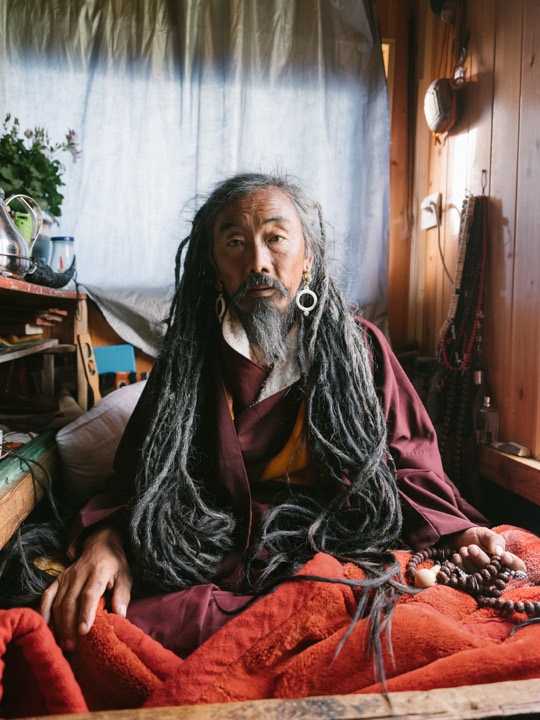
His gray-white hair reaches his knees, and a yak head hanging outside his home bears the Tibetan words: “There is a madman here, do not shout.” His retreat room is only two or three square meters, without even a bed. Every night he can only rest sitting on a narrow meditation stool.
At the request of my friend William, I needed to make offerings on his behalf to all the yogis who accepted interviews. Khenpo Jiatuo Mai gathered nearly one hundred retreat practitioners from Charang Monastery together. Many nearby Tibetans also came after hearing the news and joined the offering group. However, not all retreat practitioners accepted offerings, including the first practitioner I interviewed here—Dongsa Dorje.
From a distance, Dongsa Dorje’s gray-white long hair fell to his knees, making him stand out among the crowd like a hermit practicing far away from the world. A dried and whitened yak head hung on the fence outside his house, with a sentence written on it in Tibetan: “There is a madman here, do not shout.” This seemed to be a simple message he left for the world, and also a reflection of his inner world.
The wooden door opened less than the width of a palm. Inside, the room was only two or three square meters. A wardrobe reaching the ceiling and copper bowls, stone mortars, pots, and dishes piled on the floor occupied almost all the space, leaving nowhere to properly stand. Dongsa Dorje’s retreat room did not even have a bed. Every night he could only sleep sitting on a narrow meditation stool and was completely unable to lie down.
Dongsa Dorje is now 49 years old. Before he formally received teachings, he attended a one-hundred-day preliminary practice course at a Buddhist academy. During one class, he suddenly experienced a powerful realization: “Every day is spent repeating ordinary worldly tasks, and they never end. If one day I suddenly die, none of these worldly matters can truly be useful.” At that moment, he felt as if he had gone crazy and could no longer remain where he was.
At the Buddhist academy, he once heard a renunciant named Daji Pengcuo say: “If you truly want to seek the Dharma, you should go find Banma Luozhu Dharma King.” After hearing this, Dongsa Dorje decisively left the academy and went to Charang Monastery, where the Dharma King was located, in 2004. He never left afterward. He formally received teachings beside the Dharma King and quickly chose to enter retreat. This retreat lasted sixteen years.
I asked him: “At that time, you had just received the teachings. What made you develop such a firm determination and immediately choose retreat?”
He remained silent for a moment, then slowly said: “I suddenly understood that worldly matters never end. If I suddenly passed away, what meaning would these repetitive daily trivial things have? At that moment, I only felt that my heart had gone crazy. I could no longer stay there and only wanted to find a quiet place to practice completely.”
Regarding the Dzogchen practice he values most, Dongsa Dorje only had one sentence: “In the end, all practice returns to devotion and respect toward the teacher. With devotion, nothing else is needed. This is the only true understanding of practice that I have gained in this life and future lives.”
When I was preparing to leave, I looked back again at the simple wooden door of Dongsa Dorje’s retreat room. Under the sunset, the yak head on the fence moved slightly. The Tibetan words “There is a madman here” rose and fell in the mountain wind like pages of a scripture, as if they could be blown away at any moment.
At that moment, I suddenly understood: true practitioners may all appear somewhat “mad” to people living ordinary worldly lives. They can completely abandon worldly desires and attachments, devoting their entire lives to exploring and purifying the depths of their own minds. This courage and determination are far beyond what those of us accustomed to ordinary life can truly understand, yet they are enough to inspire deep respect and emotion.
His extremely simple way of life is almost like completely separating himself from the ordinary world.
10
“One sentence from the teacher is more precious than a thousand scriptures.”
55 years old, and he has been in retreat at Charang Monastery’s retreat center for nineteen years. He was recognized as a tulku long ago, but never mentioned it to the outside world for many years. Because disciples often come to ask him about methods of practice, his retreat room is also slightly larger than those of ordinary retreat practitioners.
Osel Dorje is 55 years old and has been in retreat at the retreat center of Charang Monastery for nineteen years. He told us that he had already been recognized as a tulku and that all related ceremonies had been completed, but throughout these years he had never mentioned it to anyone except his teacher. This time, because of our interview, he spoke about this past experience for the first time.
Unlike other retreat practitioners, his small room was much more spacious than ordinary retreat rooms. It not only had an electric rice cooker, but also a kettle specifically for boiling tea. These modern conveniences are rare in the retreat center because disciples from Han Chinese regions often come to seek his guidance on key points of practice or ask him to answer their questions. He had also asked his teacher for permission, and his teacher allowed him to explain some teachings passed down by Lang Lama to disciples. This was also one reason why he was slightly different from other retreat practitioners.
I asked him curiously: “For someone like you who has attained realization, do you still have emotions?”
Osel Dorje smiled quietly and said calmly: “It does not matter what kind of emotions an accomplished practitioner appears to show. For a truly realized practitioner, all appearances are expressions of innate awareness itself. An accomplished practitioner may appear to have joy, anger, sorrow, or happiness, but this is like the surface of water. Whether you throw a stone into the water or place a feather on it, ripples will appear, but the water itself has never changed.”
These words made me think for a long time. For ordinary people, we are always pulled along by the ripples of emotions. When the ripples rise, we become caught in emotions; when they disappear, we look forward to new stimulation. But for truly realized practitioners, emotions are only a natural expression of inner awareness. They neither increase nor decrease, and they never truly affect awareness itself.
In a later conversation, Osel Dorje further explained: “When practicing Dzogchen, having a clear understanding of the view is extremely important. Some disciples may not truly understand the teachings, but if they simply focus on meditation, it does not mean they achieve nothing. If they have strong faith in the teacher and the Dharma, they can attain Buddhahood within seven lifetimes. But if they hope to achieve complete liberation in this very life, they must truly understand the teachings and the Dzogchen view in order to practice correctly.”
He also said: “The teacher’s blessings are already complete and flawless, and the teachings themselves are also complete, but disciples may not be complete. A disciple’s shortcomings come from insufficient aspiration for the Dharma and insufficient firm faith in the teacher. If disciples truly become complete, they will be able to understand the profound meaning of the teachings.”
Before leaving, I asked him how he felt about the Dharma King. After thinking for a moment, he said solemnly: “For me, retreat practice is the most important task given to me by my teacher. Whatever the teacher asks me to do, I do. One sentence from the teacher is more precious than a thousand scriptures.”
On the way back, I looked again at Osel Dorje’s small room. The prayer flags on the roof moved in the wind, like subtle thoughts freely coming and going through empty space. At that moment, I began to vaguely understand what he meant: thoughts come and go like ripples on water. As long as we do not cling to them, the ripples naturally disappear, leaving only the nature of water that has never changed—awareness itself.
For him, emotions rise and fall like ripples on water, while awareness itself never changes.
11
“My teacher hopes that I do not meet anyone. My teacher instructed me to practice as a true renunciant.”
Moza Dharma King once publicly praised him, saying that someone with such extraordinary practice had never appeared in his retreat room before. The interview could only be conducted on the hillside outside his room, as no one was allowed to enter his retreat place.
Ridong Dorje is one of the most outstanding retreat practitioners of the present age, recognized jointly by Moza Dharma King and Banma Luozhu Dharma King. Moza Dharma King once publicly praised him: “Someone with such extraordinary practice has never appeared in my retreat room before, and I think it will be very difficult to find someone like this again in the future.”
After repeated communication between Khenpo Jiatuo Mai and Ridong Dorje, he only reluctantly agreed to our interview. However, it could only take place on the hillside outside his room, and he firmly refused to allow us to enter his retreat place. (In fact, all retreat practitioners do not allow outsiders to enter their retreat rooms.)
“My teacher hopes that I do not meet anyone. My teacher instructed me to practice as a true renunciant, and therefore I should not accept any offerings. My teacher asked me to use this way of practice to set a good example for everyone.”
When I expressed my respect for his realization, he calmly said: “I am just an ordinary person. The ones who truly have a pure mind and merit are my two teachers, not myself.”
I asked him: “For someone like you who has already attained realization through practice, is retreat the same no matter where you do it?”
He thought for a moment and answered: “Sometimes it is the same, and sometimes there are differences. But for me, whatever Khenpo Banma Luozhu Dharma King asks me to do, I do. I do not need to consider where I practice retreat, nor do I need to choose a specific method of practice. Whatever the teacher says to do, I do—this alone has completed all worldly and transcendent teachings.”
During the interview, many butterflies surrounded the hillside. They seemed to sense Ridong Dorje’s peaceful and calm presence. He gently raised his arm and sent away a butterfly resting on his sleeve, then softly said: “When I practice retreat on the mountain, birds and insects often come close. I simply give them some food and water, hoping that they can also receive some blessings.”
A bold idea suddenly came to my mind, and I asked whether he would allow me to photograph his interactions with these animals. I thought this was an impossible request, since we had not even been allowed to enter his door. Unexpectedly, he agreed without hesitation.
Ridong Dorje slowly and calmly returned to his small room, took out a bag of butter, and walked back to the hillside where we were standing. He stood in the middle of an open grassy area. He first gently threw a piece of butter onto the ground, then picked it up and threw it again. After repeating this three or four times, a small black dot suddenly appeared on the distant horizon and gradually moved closer.
Soon, a vulture landed steadily in front of him. Then came a second, a third… In less than ten minutes, dozens of vultures formed a neat line and orderly walked toward him, quietly pecking at the butter he offered from his hand. I held my breath, almost forgetting to press the shutter.
I could not help slowly moving forward, hoping to capture a closer shot. The vultures were not frightened. Occasionally, they only lifted their heads and looked at me curiously before continuing to eat quietly. At that moment, I clearly realized that their calmness and trust did not come from me, but from Ridong Dorje standing there. This seemingly ordinary elderly man carried a silent blessing power that even the birds of prey in the sky could sense and trust.
Only after the vultures had completely finished eating the butter did I put down my camera with satisfaction and deeply thank Ridong Dorje. He smiled, waved goodbye to us, and his long hair moved in the mountain wind while sunlight shone through his gray-white hair. He seemed to say something, but the wind covered his words and I could not hear them clearly. I only felt that the mountain wind at that moment was unusually gentle, as if the words he did not say were the final blessing he gave us.
Even vultures showed a calm trust toward him.
12
“The greatest supernatural ability of a teacher is not flying, transformation, or foreseeing the future. It is that when you meet him, your mind and character immediately change.”
74 years old, one of the most respected elders at Charang Monastery. He always tells stories about mice, rituals, yak epidemics, and the old days, yet everything eventually returns to the teacher and the transformation of the mind.
Along with Ridong Dorje, Cuoni Jiacuo came from Kathok Monastery to Charang Monastery for retreat. He was born in Rangtang County, Sichuan Province, is 74 years old this year, and came to Charang Monastery to become a monk in 1981. Before that, most of the large and small religious ceremonies at Charang Monastery were presided over by him. He is one of the most respected elders here.
When Cuoni Jiacuo tells stories, he always carries a sense of humor, and he seems to especially dislike mice. He told us several stories from the past, and almost all of them were related to mice.
Once, an obstacle appeared at Kathok Monastery. At that time, the retreat center was renovating its windows, and a stone accidentally fell, killing a monk. After Moza Dharma King learned of this, he immediately gathered the eight lamas in the monastery who had achieved the highest levels of practice and held a ritual to dispel obstacles. Everyone used a plate of barley and several stones as ritual implements for the practice, and they continuously recited mantras for seven days. On the morning of the seventh day, people discovered that several mice had died beneath the window. Confused, they went to ask Moza Dharma King. He calmly said: “The mice are the obstacles themselves. Now that the mice have died, the obstacles have naturally been removed.”
Cuoni Jiacuo then laughed and added another similar story: when Moza Dharma King was overseeing the construction of the Great Illusory Net mandala, a large scripture hall was built behind the mandala, and a solemn Buddha statue was installed inside. During the construction, obstacles also needed to be removed, so the ritual was performed again. The next day, people found several dead mice in the scripture hall once more.
[Note: In Tibetan Buddhism practices, there are four main methods: pacifying, increasing, magnetizing, and subjugating. The subjugation practice is used to remove obstacles and hindrances.]
At this point, he shook his head with a smile and said: “I really do not like mice, but every time this ritual is performed, it seems to have something to do with mice.”
Knowing that I was a photographer, Cuoni Jiacuo suddenly said to me seriously: “I have always had a wish: to photograph the entire retreat room in a panoramic view and preserve it as a historical record.” There was some regret in his voice, as if he thought this was a wish that would be difficult to realize. I told him that there is now a device called a drone, and taking panoramic images is very easy. After hearing this, he paused slightly, seemingly both unfamiliar with and curious about the concept of a “drone.”
I then asked him: “What kind of supernatural abilities do you think a teacher has?”
He became serious after hearing the question. After a moment of silence, he slowly said: “The greatest supernatural ability of a teacher is not flying, transformation, or foreseeing the future. It is that when you meet him, your mind and character immediately change — that kind of change is fundamental and complete.”
Then he told another story from his own experience. Years ago, a yak epidemic occurred around Kathok Monastery. Villagers asked Moza Dharma King for help, and the Dharma King sent Cuoni Jiacuo to remove the epidemic. On the way, while riding across a bridge, the horse suddenly lost its footing. He and the horse fell from the bridge and landed heavily on a huge rock in the riverbed. Yet, remarkably, both he and the horse were completely unharmed. After reaching the affected area, he immediately performed rituals, and soon the yak epidemic completely disappeared. When he returned, the villagers excitedly held a grand Mani mantra ceremony to express their gratitude.
For many years, Cuoni Jiacuo remained beside Banma Luozhu Dharma King and personally witnessed how the Dharma King maintained his commitment to Buddhist teachings without losing his original intention through major historical changes such as the Cultural Revolution and the Reform and Opening period. “Such stability and wisdom,” he said with emotion, “are absolutely beyond what ordinary people can achieve. The Dharma King’s pratimoksha vows, bodhisattva vows, and tantric vows were never contaminated by any worldly turbulence. This is what makes him remarkable.”
Before leaving, I asked Cuoni Jiacuo what his plans for the future were. He smiled slightly and said: “If there are no major obstacles, I think I will probably die here. When I passed by this place years ago, I saw the ten retreat rooms at a glance, and an inexplicable joy arose in my heart. At that time, I secretly made a vow: if I could not live here in this life, I would definitely come here for retreat in my next life. Perhaps because of that wish, it truly came true in this life. If there is another life, I will still choose to practice here.”
Finally, Cuoni Jiacuo’s voice became very soft: “I have met many teachers, and each one has their own virtues. But in front of Banma Luozhu Dharma King, I cannot say a single word. It is not because I do not know how to praise him, but because in the heart of a disciple, everything about the teacher is already complete, and any words seem pale and powerless. Only true disciples can understand this feeling.”
When I left his retreat room, it was already close to evening. The prayer flags fluttered loudly in the wind. Cuoni Jiacuo stood alone at the doorway, looking toward the distant mountains, his gaze calm and far away — the kind of peace and freedom that a retreat practitioner possesses when facing life, the teacher, and his own mind.
Behind his humor is an extremely firm faith.
13
“As long as Banma Luozhu Dharma King is still here, I will continue my retreat practice with peace of mind.”
48 years old, yet long-term retreat practice and exposure to wind and sun have made him appear much older than his actual age. At 33, he began his path of retreat practice under the Dharma King and has now continued for a full fifteen years.
When I first met Tabo, I thought he was around the same age as Cuoni Jiacuo. Later I learned that he was actually only 48 years old. Years of retreat practice and exposure to wind and sun have made him look much older than his actual age.
Tabo was born in De'ang Township, Dari County, Golog Tibetan Autonomous Prefecture, Qinghai Province. He became a monk at the local De'ang Monastery at the age of 16. When he was 33, Banma Luozhu Dharma King traveled to De'ang Monastery to hold a grand Great Illusory Net practice. At that time, Tabo was the only monk in the monastery, and through this connection he formed an extraordinary relationship with the Dharma King. He received the most important practice instructions from him and began his path of retreat practice. It has now been exactly fifteen years.
Before practicing under Banma Luozhu Dharma King, Tabo also received precious teachings and instructions from Guobao Rinpoche and Ak Banma teacher. Guobao Rinpoche especially left a deep impression on him. He told a story he witnessed himself: Guobao Rinpoche possessed the ability to know others’ thoughts and could clearly understand their minds. Once, a patient with a serious mental illness was brought to him for help. Guobao Rinpoche simply recited scriptures and mantras for the patient, and the patient soon recovered, leaving people amazed by the level and ability of his practice.
Tabo also told a small story related to Guobao Rinpoche. Once, on a rainy day, a prayer wheel was soaked by the rain. Some disciples suggested building a shelter to protect it, but Guobao Rinpoche smiled and stopped them: “Can rain damage a prayer wheel? As long as the heart is sincere, the prayer wheel will turn by itself. That is what matters most.”
When speaking about his feelings toward Banma Luozhu Dharma King, Tabo’s voice suddenly became gentle: “Only after the Dharma King came to De'ang Monastery did my life truly find its direction. During these years of practicing beside the Dharma King, I have only one thought in my heart: no matter what happens, I will follow the teacher’s instructions and practice well.”
When I asked about his plans for the future, Tabo thought for a moment and then calmly said: “As long as Banma Luozhu Dharma King is still here, I will continue my retreat practice with peace of mind. I have never considered the length of life. I only wish to follow the teacher life after life and complete my own practice.”
Before parting, Tabo used a prayer text written by the treasure revealer Tashi Pengcuo for the Dharma King to express his deepest blessing: “May the teacher’s practices of Trekchö and Tögal be perfectly accomplished and ultimately arise naturally. May disciples and the teacher become inseparable, with their minds united as one.”
Tabo speaks softly, yet every sentence is as firm as vajra words. Beneath his calm appearance, I saw the qualities most precious in a practitioner: unwavering faith, complete devotion to the teacher, and an unshakable dedication to Buddhist teachings.
His determination carries almost no embellishment.
14
“As long as the teacher is alive, I will stay here and continue my retreat practice.”
53 years old, he spent years in retreat at Kathok Monastery, Zuoqing Monastery, and Samye Monastery, and also served as an Acharya for three years. In the end, he still chose to return to the retreat room and place actual practice before teaching.
Dedo is 53 years old and was born in De'ang Township, Dari County, Qinghai Province. At the age of 21, he entered the Buddhist academy at Kathok Monastery. After completing three years of study and contemplation, he began a long period of retreat practice. He spent six years in retreat at Kathok Monastery, followed by one year at Zuoqing Monastery and five years at Samye Monastery. After reaching a certain level of practice, Dedo was appointed by the monastery to serve as an Acharya at De'ang Monastery for three years, responsible for guiding young monks in their Buddhist studies.
I asked him what the biggest difference was between being an Acharya and practicing in retreat. He humbly said: “Serving as an Acharya requires the true ability to guide sentient beings toward liberation, and I feel that I currently do not have enough merit and wisdom to truly help others become liberated. Therefore, I still prefer dedicated retreat practice, because this allows me to improve myself more solidly and benefit sentient beings in the future.”
[Note: An Acharya is a teacher in Tibetan Buddhism who is responsible for teaching Buddhist teachings to disciples and guiding their practice.]
Recalling his experiences of retreat in different monasteries, Dedo said: “Although the feelings at each retreat place were different, what ultimately truly affected my mind was my faith in my root teacher, Banma Luozhu Dharma King. Only when practicing beside the teacher can my heart truly feel grounded and peaceful.”
When Dedo was 27, he received precious practice instructions from Anzun Zhuba, and at 29 he received deeper practice guidance from Ak Banma teacher. He told me: “The people who have shown me the greatest kindness in this life are Ak Banma teacher and Banma Luozhu Dharma King. Without their compassionate teachings and blessings, I could never have come this far.”
When I asked about his future plans, he answered without hesitation: “As long as the teacher remains in this world for one more day, I will stay here and continue my retreat practice.” After saying this, he quietly prayed: “May the teacher live long and continue turning the Dharma wheel.”
Before leaving, he solemnly said to me: “I hope everyone’s faith in the teacher will never diminish. For disciples, faith is the true foundation of accomplishment in practice.”
After saying this, Dedo put his palms together, smiled, and waved goodbye to us. When I looked back, I saw him still standing on the hillside, watching us leave. The countless prayer flags behind him moved gently in the mountain wind, as if silently carrying his prayers and blessings.
He sees retreat as a more solid preparation before benefiting others.
15
“As long as the teacher is here, I will definitely stay here; if the teacher is no longer here, I would not be able to remain.”
46 years old, he lived with his mother at the monastery for nearly ten years in his early years. Only after his mother passed away did he truly begin his own practice. During retreat, he twice completely cleared out everything he owned, including valuable antiques.
Garma Qiongzhi is 46 years old and was born in Yadang Township, Dege County, Sichuan Province. At the age of 18, he became a monk at Danpei Monastery in his hometown. After becoming a monk, according to the monastery’s arrangements, he often went to Tibetan families to recite scriptures and offer blessings. During this period, he lived with his mother at the monastery for nearly ten years. Only after his mother passed away did he truly begin his own practice.
In his early years, Garma Qiongzhi received precious practice instructions from Banma Danzeng, a disciple of Anzun Zhuba. He later practiced retreat at Sangye Qingpu for two or three years, then traveled to a sacred place in Tibet — where the venerable Milarepa once practiced retreat — and continued retreat there for five or six years. During his retreat at Sangye Qingpu, he heard that Banma Luozhu Dharma King, whom he had admired since childhood, had also arrived there, which greatly excited him. Without hesitation, he decided to go meet this widely respected teacher, and soon became a disciple of Banma Luozhu Dharma King.
Garma Qiongzhi recalled: “I had heard the name of Banma Luozhu Dharma King since I was young. Everyone in my hometown praised him as one of the most extraordinary masters teaching Dzogchen throughout Tibetan regions. From that time on, strong faith arose in my heart, and I always hoped that one day I could truly meet him. But at that time, the conditions were not complete, and I did not know when this wish could come true.”
Many years later, when he finally met the Dharma King for the first time at Sangye Qingpu, the faith and emotions he had accumulated over the years suddenly burst out. I only mentioned Banma Luozhu Dharma King’s name, and his tears began to fall uncontrollably. His voice also became choked and low.
I asked him what difference there was between the faith he had when he first heard the Dharma King’s name as a child and the faith he has now after receiving teachings and completing seven years of retreat practice.
He was silent for a moment, then said seriously: “The faith I had as a child was a longing for the unknown. Although it was strong, it was still somewhat vague. After truly receiving the teacher’s instructions and practicing in retreat for many years, my faith is completely different now. The faith I have now is absolutely unwavering — if the teacher asked me to jump into the Yellow River at this moment, I would walk toward the river without hesitation. But at the final moment of life, whether I can truly let go of everything, I myself cannot be certain.”
Garma Qiongzhi paused for a moment and continued: “As long as the teacher is here, I will definitely stay here; if the teacher is no longer here, I would not be able to remain. The thing I fear most in my heart is losing the teacher.”
At this point, his eyes revealed a deep concern. It was the sincere care and dependence that a true disciple has toward his teacher.
During retreat, Garma Qiongzhi twice completely cleared out all the possessions he owned, including some valuable antiques. These things may be difficult for ordinary people to let go of, but to him they were obstacles that would only increase attachment in his mind.
After the interview, on the way down the mountain, I met Dongsa Dorje again. He and several monks were setting up tents. A nearby yak had been injured by a wolf, and they were removing parasites from it. After completing the treatment, these monks would also specifically recite prayers and dedicate merits for the insects that had been removed.
Looking back, Garma Qiongzhi’s retreat room could be faintly seen on the hillside. I suddenly felt a strange sense of calm, as if I too had touched a little of the purity and freedom of a retreat practitioner. Perhaps true practice is like this: external things will eventually pass away, and only the faith in the teacher and Buddhist teachings within the heart remains as a lamp that never goes out.
He sees all external possessions as obstacles.
16
“The teacher tells me what to do, and I do it.”
63 years old, he was one of the earliest practitioners to enter the retreat rooms at Charang Monastery and has remained in continuous retreat for 24 years. For him, the meaning of retreat is not to achieve extraordinary abilities, but to live out the simplest promise.
Langri Dorje is 63 years old this year and was born in the Charang community of Jimei Township, Dari County, Qinghai Province. When he was 36, his mother and maternal uncle passed away one after another. His elders had always hoped that he would become a monk and practice, so he made a vow and came to Charang Monastery, where he formally received vows from Dabeiding Rinpoche and began his monastic life.
After becoming a monk, he spent three years completing the preliminary practices and, at the age of 37, formally received precious instructions from Banma Luozhu Dharma King. The Dharma King once told him: “Your family conditions are relatively good, and you do not lack anything in life. Therefore, the best way to practice is not to accept offerings from the ten directions. If life is truly difficult, you may occasionally participate in monastery ceremonies and recite scriptures to support yourself. But none of these are the most important things — for you, repaying the kindness of your parents and making the best offering to the teacher is to practice seriously in retreat.”
Following the teacher’s instructions, Langri Dorje chose retreat without hesitation. When the Charang Monastery retreat center had just been established with its first four retreat rooms, he was one of the earliest yogis to enter and practice there. He has now remained in continuous retreat for 24 years.
When I asked whether he had ever considered other ways of benefiting sentient beings, such as attending ceremonies or reciting scriptures for believers, he gave a very simple answer: “The teacher tells me what to do, and I do it. I have never thought about anything else.”
Langri Dorje was the simplest and most direct retreat practitioner we encountered during our interviews. He does not speak much. No matter what we asked, his answer was always one sentence: “Listen to the teacher.”
He said frankly: “My thoughts are actually not very different from those of an ordinary person. In the past, I once told the teacher: ‘When you are here, I will practice well; when you are gone, I do not know what I will do.’ The teacher then criticized me: ‘Do not only think about what happens when I am here. You should think about how you will continue when I am not here. Everything comes down to the Dharma. You must seriously complete your own practice.’ After hearing this, I replied: ‘Alright, teacher. If you say it must be completed, I will definitely complete it. You must live for a long time, and I will stay here for my whole life.’ The teacher comforted me and said: ‘For you to stay here for your whole life is already the most complete thing.’”
At the end of the interview, I asked him to pray and offer blessings for us. He smiled humbly and said: “I do not know anything, and I do not know how to bless others. All I know how to do is keep all of you in my thoughts.” After saying this, he lowered his head and quietly recited the name of Banma Luozhu Dharma King. For him, this itself seemed to be the most precious prayer.
Langri Dorje’s retreat room remains quietly on the hillside, and years of practice have made him accustomed to this life. For him, the meaning of retreat is not about achieving some extraordinary supernatural ability, but about using his life to fulfill the simplest trust and promise to the teacher: “The teacher tells me what to do, and I do it.” The sentence sounds simple, but how many people can truly do it?
He speaks very little, yet it feels as if he has expressed an entire lifetime.
17
“As long as the teacher is alive for one more day, I will definitely stay here.”
51 years old, he was once a highly skilled thangka painter. Later, he completely gave up painting and recognition, seeing retreat as the only place where he could truly feel progress in practice.
Puba Tashi is 51 years old this year and was born in Jiazhi Township, Xinlong County, Sichuan Province. At the age of 14, he became a monk at Jiazhi Monastery in his hometown, where he was personally ordained by Lungdo Rinpoche. Later, he came to Larung Gar Buddhist Academy and formally studied Buddhist teachings under Jikme Phuntsok Dharma King. During his time at the academy, Jikme Phuntsok Dharma King once seriously instructed them: “You must carefully complete the preliminary practices. In the future, I will teach you an extremely precious Dharma — The Heart Essence of the Guru.” However, before the transmission could take place, the teacher passed away, which caused him great pain for a long time.
After the teacher passed away, his heart remained unsettled. He spent three full years searching everywhere for a teacher who was truly suitable for him. He visited many places, but was never able to find someone who gave him complete peace of mind. Until he met Banma Luozhu Dharma King — he clearly recalled: “When I saw the Dharma King for the first time, I felt that he was exactly the same as Jikme Phuntsok Dharma King, without any difference. At that moment, my heart finally became truly settled.”
Puba Tashi was originally a highly skilled thangka painter. More than forty solemn thangkas in the famous Karma Scripture Hall of Kathok Monastery were painted by him together with his nephew. At that time, his reputation had spread widely, and many lay practitioners from mainland China even offered to support him in establishing a thangka academy in Chengdu. However, by then he had already felt deep confusion: “There are too many temptations in worldly life. If this precious human life is wasted like this, it has no meaning at all.”
Although he had gradually developed a wish to leave worldly life behind, family responsibilities still weighed heavily on his shoulders and were difficult to let go of. “Before, I had many attachments to worldly things. Being the pillar of my family placed a heavy responsibility on me. I wanted to let go, but I did not have enough courage,” he said. “It was only after meeting Banma Luozhu Dharma King that my life underwent a complete transformation. From that moment on, I completely let go of all worldly concerns and stayed here peacefully to practice in retreat.”
He originally had no plan to practice long-term retreat at Charang Monastery. At first, he only wanted to stay there temporarily before going to circumambulate Maji Snow Mountain. But after completing the circumambulation and seeing the Dharma King again, great faith arose in his heart, and he decided to remain in long-term retreat and never leave.
When I asked him how he currently feels about retreat practice, he answered: “As long as the teacher is alive for one more day, I will definitely stay here. Everything in the world is impermanent, and no one knows what will happen tomorrow. But if the choice were mine, whether I were to practice beneath Venerable Bodhi Kashyapa’s Bodhi tree or enter retreat at any other sacred place, I would still choose this place. Because only here can I truly feel the progress of my practice.”
Today, Puba Tashi has completely given up thangka painting. He said with emotion: “At first, I painted thangkas because I believed creating images of the Three Jewels brought great merit. But gradually, this became a way to make money and became mixed with too many worldly elements, so I completely let it go.”
I asked him what was the hardest thing for him to let go of now. He answered frankly: “Family affection is the hardest thing for me to let go of. My younger brother is not in good health. After I came here for retreat, I originally did not want to accept any offerings and thought that as long as I did not starve, it would be enough. But the teacher required all of us to accept offerings from believers as a way to form connections.”
Recalling the time when he first became a monk as a young man, he smiled and said: “At that time, becoming a monk did not come from any particularly strong wish to leave worldly life. The monastery arranged for young people to become monks, and I simply followed along. Back then, I was only an ordinary novice monk and never imagined that I would later take the path of retreat practice.”
After the interview, Puba Tashi softly mentioned a prayer by the master Jigme Lingpa: “Everything worldly and within samsara is like a prison and a pit of fire.” He admitted: “In the past, I did not even dare to make such a vow, because my mind was still full of attachments. Now, under the guidance of Banma Luozhu Dharma King, I finally have the courage to make such a precious aspiration.”
The mountain wind passed over the retreat room, and the prayer flags on the roof fluttered as if quietly reciting scriptures. Puba Tashi stood in front of the room and watched us leave. His firm yet peaceful expression made people believe that there was no longer hesitation in his heart. Only the teacher’s instructions and his lifelong practice remained as his true destination.
From a thangka painter to a long-term retreat practitioner.
18
“I have especially longed for retreat practice since I was young, and even before becoming a monk, I was already full of yearning for the life of retreat.”
He was 32 years old at the time of the interview, the same age as me. He was the youngest retreat practitioner at the Charang Monastery retreat center, yet he had already spent fifteen years in retreat. After receiving teachings at the age of 18, he entered the retreat room without hesitation and never left.
Genhua was 32 years old at the time of the interview, the same age as me. He was the youngest retreat practitioner at the Charang Monastery retreat center, yet he had already practiced in retreat for fifteen years. He was born into the Charang family of the Tangwa community in Dari County. At the age of 13, he was ordained by Wose Khenpo. At 18, he received precious instructions from Banma Luozhu Dharma King and began his path of retreat practice.
When he was young, he attended school, but no matter how the teachers taught him, he seemed unable to learn anything. He was considered a typical “poor student.” However, after leaving school and returning to the monastery, everything seemed to come naturally, as if the seeds of practice from a previous life had awakened at that moment.
Genhua recalled: “Actually, I especially longed for retreat practice since I was young. Even before becoming a monk, I was already full of yearning for the life of retreat.”
At the age of 18, after formally receiving teachings, Genhua understood that if he did not practice seriously, the precious teachings he had received might gradually be lost. Therefore, he discussed it seriously with his family and eventually gained their support and understanding. He entered the retreat room without hesitation. The first three years were spent in the Vajrasattva retreat room below the monastery mountain. During the Spring Festival of 2008, he came to the retreat center at Charang Monastery and has never left since.
I asked him: “What is the difference between life in retreat and your previous life at the monastery?”
He thought for a moment and said: “At the monastery, although we also study, contemplate, and practice every day, we are still disturbed by many daily tasks. Retreat is different. There is almost no outside interference here, so practice becomes more focused and deeper.”
Even so, retreat does not mean that emotions completely disappear. I asked curiously: “After so many years in retreat, do you still experience emotional fluctuations?”
Genhua answered honestly: “Emotions are still there. Although we often say that everything is impermanent, when something as significant as the death of a family member truly happens, the heart is still moved. My uncle was once the head of a Buddhist academy. When he passed away, I felt enormous grief. At that time, I had only been at the retreat center for two years. I comforted my family by saying that everything is impermanent, that they should not be overly sad or attached, but in my own heart, I was also very sad.”
When speaking about whether he would have other forms of practice or life plans in the future, he said firmly: “In life, being able to meet a teacher and encounter such a precious Dzogchen teaching is an opportunity that is difficult to find even over countless lifetimes. For me, there is nothing more important than this. I will never give up or lose this way of practice.”
“If you were asked to practice beneath Venerable Bodhi Kashyapa’s Bodhi tree, or continue your retreat here, how would you choose?” I asked him again.
He answered without hesitation: “Of course I would still choose here, because only here can I truly experience progress in Dharma practice.”
Near the end of the interview, I asked him to offer some advice to young practitioners living in cities. He said calmly and firmly: “The most important thing is to have faith in the teacher like faith in the Buddha, and to have genuine and unwavering devotion to the Dharma. The practice of ultimate meaning comes from faith and devotion. The tantras of Dzogchen say that even if one does not fully accomplish practice in this life, as long as one truly encounters this Dharma and has faith, one will certainly attain Buddhahood even after seven lifetimes. Unfortunately, many people use this as an excuse to become careless and lazy, and this is something to be aware of.”
I finally asked him: “How do you view giving up family and worldly life for the sake of practice?”
Genhua answered steadily: “If one can let go of all worldly attachments for the sake of the Dharma, then of course that is the most precious thing.”
When we parted, he put his palms together and sincerely prayed: “I dedicate all the merit from my practice to Banma Luozhu Dharma King. I sincerely pray that the teacher may live long and continue turning the Dharma wheel.”
His voice was not loud, but it carried an unshakable faith and determination. In his eyes, retreat practice was not an escape from reality. It was because there was nothing else in life more important or more valuable than this.
Young, yet with an unusually steady faith.
19
“Since entering the retreat room, I have never thought about going anywhere else.”
77 years old, one of the longest-practicing retreat practitioners at the center. When he was young, he herded livestock and cared for his father. Until the Dharma King said again: “You should go practice in retreat.” From that moment, he never intended to leave.
Ugyen Dorje is 77 years old this year and was born in the Charang community of Jianshe Township, Dari County. When he was in his thirties, he became a monk at Charang Monastery and was personally ordained by Dabeiding Rinpoche. In the second year after the retreat center was established, he came here to practice in retreat. Until now, he has become one of the longest-serving practitioners at the retreat center.
Recalling the past, Ugyen Dorje only said lightly: “Since the 1950s, I had always been herding livestock on the grassland, and there was nothing particularly special about my life. Shortly before liberation, I briefly became a monk for a period of time. Later, policies no longer allowed it, the monasteries were closed, and I could only return to herding livestock until the Reform and Opening period.”
When he was in his forties, Banma Luozhu Dharma King once instructed Ugyen Dorje to go to Mense Rinpoche to receive precious teachings. However, at that time he needed to care for his elderly father, so he kept postponing his plan to seek teachings and spent every day carefully taking care of his father’s daily needs. Only after his father passed away did he begin reconsidering his path of practice. Later, the Dharma King told him again: “You should go practice in retreat.” From that moment, he entered the retreat room without hesitation.
“Since entering the retreat room, I have never thought about going anywhere else,” he said calmly. “I do not say any great principles. I only know that the teacher is complete, and everything he says is complete.”
When I asked him about his plans for the future, Ugyen Dorje smiled slightly and slowly said: “I am already this old. Where could I go? I do not want to go anywhere else. If I become sick, perhaps I will go out to see a doctor, but apart from that, I have no other plans. I only hope to complete my life here. But as for whether I will pass away in the retreat room or outside, I do not know.”
Speaking about his blessings for the Dharma King, he sincerely said: “The Dharma King told me that it would be best to complete my practice here. My blessing for the teacher is simply to completely follow his instructions.”
When we parted, Ugyen Dorje looked at us kindly and said softly: “After hearing about your situation, I will recite Buddha’s name for you and dedicate the merit. I do not have any special power to give blessings, but I know that cause and effect are never false. For all these years, it is this belief that has allowed me to sit here peacefully and practice in retreat.”
After saying this, he gently put his palms together and recited a Buddha’s name for us. His voice was low, yet clear and firm. I watched his back gradually disappear at the entrance of the retreat room, and felt an indescribable warmth and peace. Perhaps the practice of his entire life can be summed up in this simple sentence: “Listen to the teacher in everything.”
He sees the rest of his life as a complete life here.
20
“The teacher can do it, and I can do it too!”
83 years old, he has experienced marriage, family, and the pain of losing his wife. In his fifties or sixties, he truly developed a strong wish to leave worldly life and practice in retreat. Today, he is still responsible for the sky burial site at Charang Monastery and recites the Mani mantra for one hour every day.
Dongga is already 83 years old this year and is the oldest practitioner at the Charang Monastery retreat center. He was born in Sangrima Township, experienced marriage and family life, and also endured the great pain of losing loved ones. He became a monk around 1982 or 1983, and it has now been more than forty years. When he was in his fifties, Dongga’s wife passed away. He took his son and brought his wife’s hair and clothing to different sacred places to pray for liberation and blessings. This wandering life lasted for two or three years.
When he was in his fifties or sixties, he truly developed a strong wish to leave worldly life and chose retreat practice. He said frankly: “When my loved ones left this world, I truly realized that samsara has no meaning. Everything I was attached to in the past — family, wealth, and land — lost its original value. When I first chose retreat, perhaps it was partly an attempt to escape reality. But after truly entering retreat, I completely let go of everything worldly. Now everything I need in life is completely given by the teacher.”
Dongga is currently the person responsible for the sky burial site at Charang Monastery. Because of the special nature of sky burial, he spends one hour every day devotedly reciting the Mani mantra to benefit those who have passed away. I asked him: “When practicing at a place as special as a sky burial site, can you feel the existence of beings in the other realms?” He smiled, shook his head, and calmly said: “No, nothing at all.”
I asked him again: “When you decided to enter retreat, what kind of thoughts and determination did you have in your heart?”
He answered: “Before I had the wish to leave worldly life behind, I could not let go of those worldly possessions and attachments no matter what. But after truly hearing the teacher’s instructions, my state of mind completely changed. At that time, I had only one thought in my heart: the teacher can do it, and I can do it too!”
“Did the life of becoming a monk and practicing in retreat truly solve all your suffering?” I continued asking.
Dongga answered calmly: “The ultimate purpose of practice is to completely become free from suffering. Becoming a monk and practicing does not immediately solve every problem, but at least it has allowed me to see clearly that everything worldly is empty and impermanent by nature. Now, apart from waking up, meditating, and practicing, I no longer think about anything else.”
When speaking about his plans for the future, he said: “If the teacher tells me to die here, I will die here. If the teacher tells me to do something, I will do it.”
Finally, I asked him whether his understanding of “accomplishment” and “liberation” in practice had changed over the years. Dongga was silent for a moment, then slowly said: “When I first received the teachings, I thought ‘attaining Buddhahood’ was a distant and specific goal. But now I understand that true liberation is actually found only in the meditation and present awareness of each day.”
When we parted, he looked at us and smiled kindly: “This is how the teacher practices, and this is how you should practice as well.” After saying this, he lowered his head and continued silently reciting the Mani mantra. The sound of the wind around us seemed to become gentle as well.
From great suffering, he moved toward complete retreat practice.
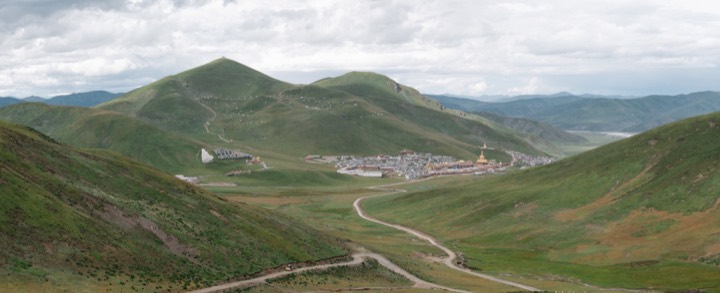
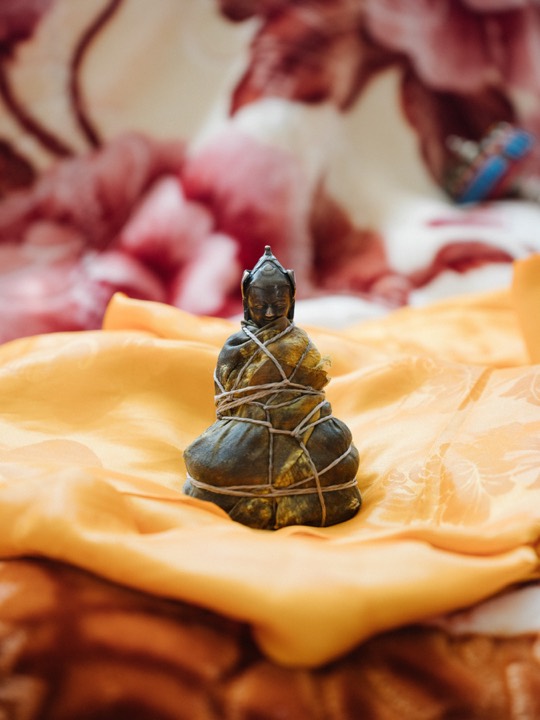
The Third Door
Every image is another doorway.
Look slowly.
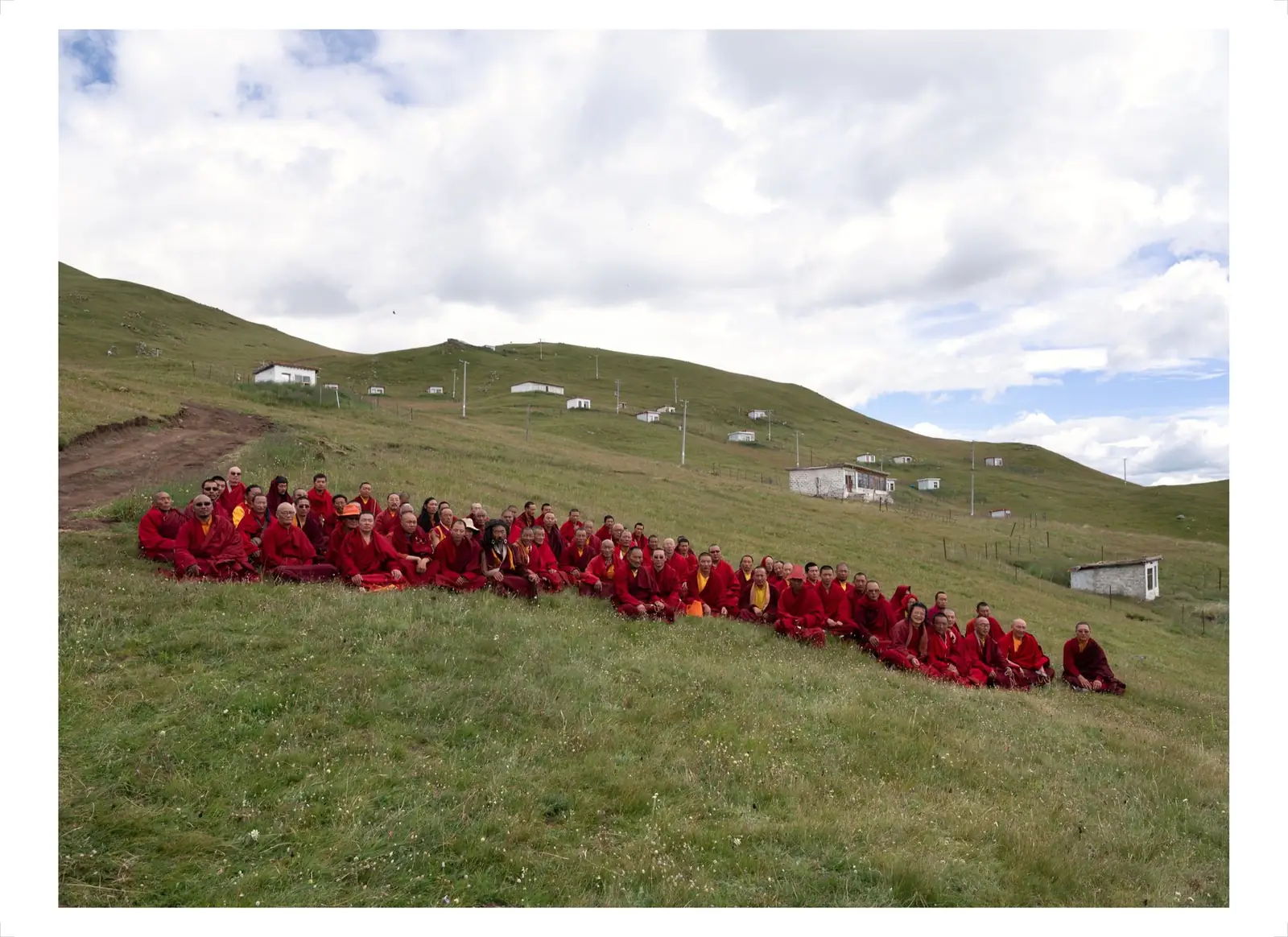
Returning Wind
The Buddhist scriptures say: All conditioned things are impermanent, like dreams, illusions, bubbles, and shadows. This journey between the plateau and the city felt like a long dream. After waking, I continue turning the beads in the night of Beijing, turning time itself.
At this moment, Beijing was deep in the night. The elevated bridge outside the window slowly turned like a huge steel prayer wheel. The beams of car lights brushed across the glass, like the echo of the yak skull hanging outside Dongsa Dorje's door, or like the handful of blessing rice that Moza Dharma King scattered toward a Buddha statue — fleeting, yet leaving a faint light in the heart. When I opened the door of my home, everything remained unchanged: the computer on the desk was still glowing with its screensaver, the warmth of dinner still lingered on the dining table, and the recitation machine on the cabinet quietly played the chanting recorded by my teacher. The city's night was so full that it seemed to erase the plateau's silence inch by inch with neon lights and human voices.
As usual, I laid out the cushion and held my hands together to recite mantras. The prayer beads between my fingers were given to me by the Khenpo and had received blessings from all the great masters mentioned above. The mantra turned round after round, yet was often interrupted by the vibration of my phone, the delivery bell, and the siren of an ambulance speeding past downstairs. Halfway through the recitation, I suddenly remembered the tears in Sadong Dorje's eyes when he said “listen to the teacher's words”; I remembered the faint moonlight reflected on the bone surface of the kapala bowl when Dezhuo shared yogurt from it; I remembered the words “there is a madman here” written on Dongsa Dorje's wooden door, swaying in the mountain wind. The beads completed one round, yet I vaguely no longer knew how many times I had recited. I felt quietly ashamed: behind Charang Monastery, a single candle could burn for three months; here, before a single stick of incense had finished burning, my thoughts had already carried me away several times.
Only a few years after leaving, Moza Dharma King, the father of the rainbow light tradition of Kathok, had already departed in light beside the lotus seat; Tangre Rinpoche also passed away with his daughter beside him; Banma Chenlie, the tertön I never had the chance to meet, left behind only a trail of terma legends still waiting to be unfolded. The wind of the plateau still writes upon the prayer flags, while the impermanence of human life quietly leaves its mark — when Tashi Dondrub spoke the four words “renunciation, cave, and death,” his voice was extremely soft. It was only after I returned to the traffic flowing like water around Beijing's Third Ring Road that I truly heard the weight within that quiet voice.
Of course, new news also arrived: another young yogi under Mense Rinpoche entered retreat on Haixin Mountain; it was said that the bell of another bhikshu’s morning recitation had begun to ring in the stone caves of Zuoqing; and an unknown practitioner who observes silence was using silence to trace the earth in the homeland of Gesar. Memory is like a flickering butter lamp: on one side it reflects the departing figures of those who passed into rainbow light, and on the other it reflects the footsteps of new practitioners entering the gate of the mountain.
I simply continued my daily practice: at seven in the morning, I marked a check in my phone calendar; at midnight, I lit the small lamp on my desk and read a few pages of explanations of the Dzogchen preliminary practices. Progress was extremely slow, yet it was real — like the gradual warming of Beijing's heating in winter nights, like a faint blue appearing occasionally through polluted skies. I dare not claim realization, nor speak of achievements in this life; I can only try to distinguish ripples from water during the daily acts of “counting repetitions,” reminding myself as thoughts rise and fall: ripples will eventually settle, while the coolness beneath the water's surface has never been shaken.
Some people say that purity is difficult to find in the city. Yet I think of Xiazha Qiuyang's smile as he looked up at the prayer flags from his wheelchair — he was far from the Buddha hall, yet close to all beings. Perhaps the true cave is in the heart: when the sound of wind becomes the voice of chanting, when the reflection in a mirror becomes the realm of Dharma, even a bedroom can become a retreat room; when the teacher's words are remembered and practiced, even a sidewalk can lead toward rainbow light.
The Buddhist scriptures say: “All conditioned things are impermanent, like dreams, illusions, bubbles, and shadows.” This journey between the plateau and the city felt like a long dream. After waking, I continue turning the prayer beads in the night of Beijing, turning time itself. If one day I hear that rainbow light has arisen again in some cave, perhaps I will pack my belongings and set out once more — carrying the old prayer beads, quick-acting heart medicine, and a still-clumsy faith, to meet those “madmen” who remain in this world and are still willing to speak, and also to search for the next truly refreshing wind for this small and slow progress of my own.
The wind moves across the grass slope, and the robes appear like a long red line, slowly placed between the mountains. Unlike the narrow, dim, and nearly motionless retreat spaces shown earlier, this group portrait brings practice back into openness and allows the entire work to leave one final breath of genuine expansion.
When individuals reappear as a collective after the caves, wooden doors, and scriptures, retreat does not lose its secrecy. Instead, another layer of meaning becomes clearer: it is not an escape from the world, but a different way of responding to the world through the long passage of years.
Traces Left Behind
The rise and fall on paper is quieter than a voice, and lasts longer.